


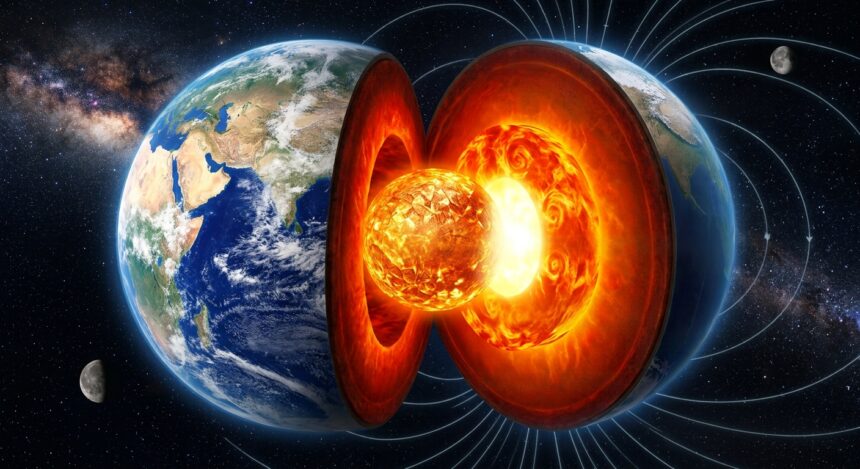
A study conducted by researchers at the University of Alberta revealed that Earth’s inner core is changing the length of the day. Relying on observational records spanning six decades, the researchers found that interactions inside the planet are altering its rotational speed, causing Earth’s rotation to slow by milliseconds over the decades.
How Is Earth’s Inner Core Changing the Length of a Day?
Earth’s inner core, surrounded by a sea of liquid iron, is wrapped in a thick shell comprising the mantle and crust. The inner core rotates at a different speed than the outer layer. The gravity of these two layers pulls on one another. Therefore, when the inner core moves out of alignment, the gravitational pull tries to drag it back. This creates a torque that either speeds up or slows down Earth’s surface. Consequently, this chances the duration of Earth’s rotation.
The liquid outer core between the inner core and the mantle of Earth creates magnetic and physical friction between the two layers. The friction resists the gravitational pull, preventing extreme fluctuations in the planet’s speed.
Between the 1970s and 2021, these forces altered the length of the day by a few milliseconds. For decades, scientists noted that apart from predictable seasonal and atmospheric variations, the length of the day still varied by a few milliseconds. Therefore, scientists relied on complex statistical models to analyze six decades of data.
Implications
GPS satellites work best when precisely aligned with Earth’s physical position in space. Scientists can now incorporate these precise measurements of rotational variations into planetary tracking systems to improve navigational accuracy.
These findings will also help keep atomic clocks aligned with Earth’s actual physical rotation. They will also assist global technology organizations in predicting Earth’s rotational speed with much more accuracy, making global timekeeping an easier task.
More accurate measurements could significantly improve satellite positioning, telecommunications, financial transaction timestamps and scientific observations. These systems rely on highly precise clocks. Therefore, even tiny discrepancies between atomic time and Earth’s rotation can accumulate and eventually require correction.