


New research from the California Institute of Technology (Caltech) reveals that the Solar System is terminally unstable and will break apart a billion times faster than previously calculated. Roughly one billion years after the death of the Sun, the outer planets Jupiter, Saturn, Uranus, and Neptune, will be ejected from the Solar System. Previously, scientists maintained that the giant planets’ orbits would remain stable for roughly a billion billion years. However, this new research dramatically lowers our understanding of the lifespans of these planets. The reasoning for this is tied to how the Sun’s death will disrupt gravitational balances.
The Solar System will collapse in two phases as the Sun runs out of fuel in roughly 5 billion years from now.
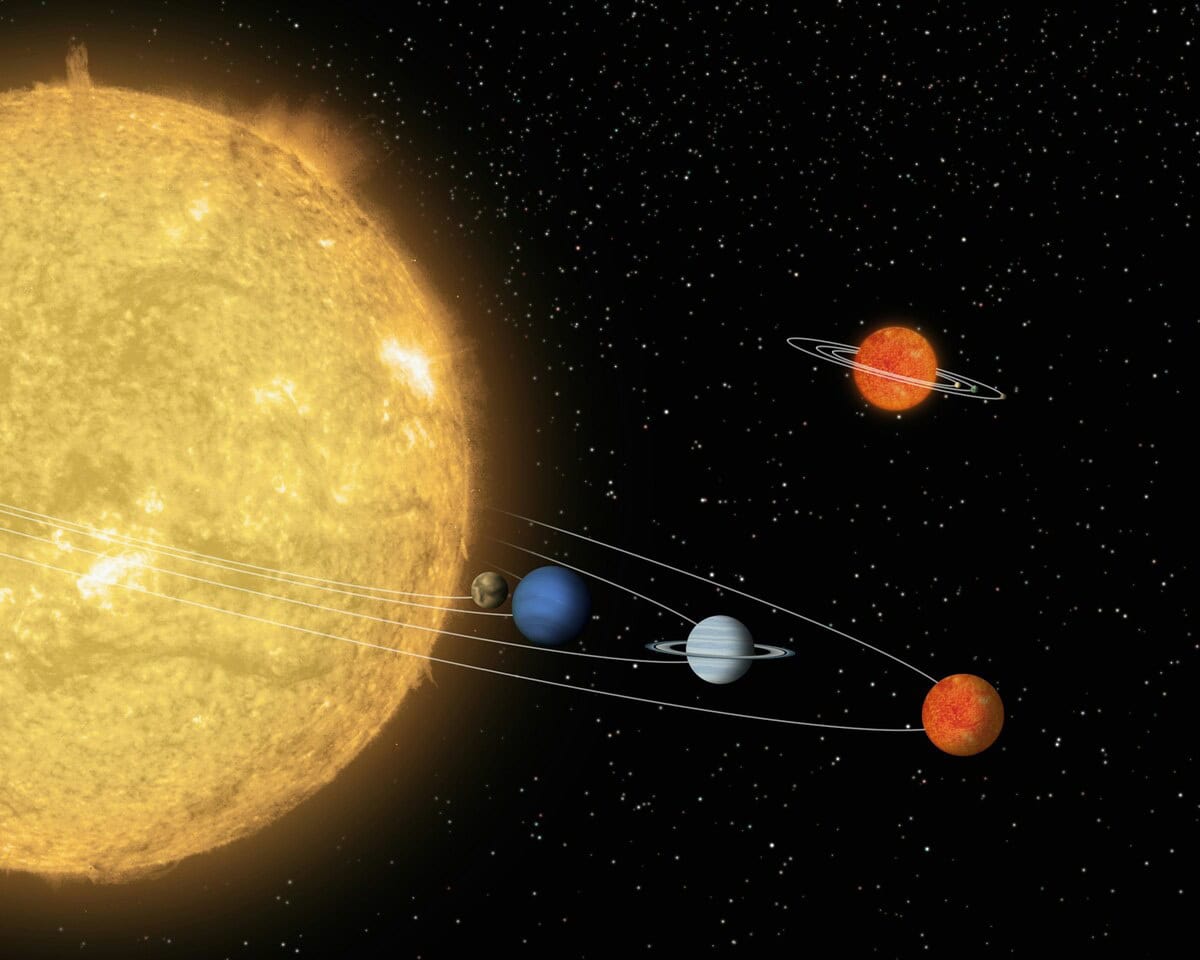
In phase 1, roughly 5 billion news from now, the Sun will burn through its hydrogen core. Consequently, it will expand into a massive red giant. Mercury and Venus will then be engulfed and consumed by the expanding star. Previous scientific consensus concluded that Earth would share the same fate. New research suggests that as the Sun sheds mass, its gravitational pull will weaken. This will cause Earth to drift into a wider orbit and avoid being physically engulfed, although its surface will become uninhabitable. Researchers say Mars will be able to survive this phase due to its distance.
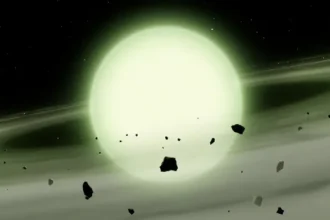
In phase 2, roughly 1 billion years later, the Sun will shrink into a white dwarf. This will cause it to lose about half of its original mass. Previously, scientists such as Isaac Newton believed that the Sun would shed mass smoothly. Further, they believed that the outer gas giants would also settle into stable, wider orbits. However, the new research claims that the Sun’s mass loss will trigger an orbital resonance. Without the Sun’s strong central gravity to anchor the outer planets, they perturb one another. Consequently, this will result in the entire outer Solar System dissolving.
The Caltech team concluded that the destabilization process can trigger much sooner than previously anticipated. When scientists used supercomputer simulations, 4 out of 10 times, the planets violently crossed each other’s paths causing them to eject one another of the system much earlier than previously predicted. This happened while the Sun was actively dying.