




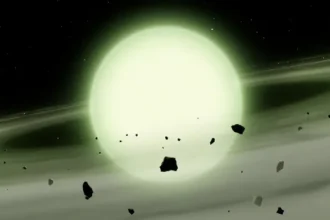
Astronomers have found evidence of a planet that appears to have formed after its host star died, assembling from material the star expelled into space. The discovery suggests that the end of a star’s life can give a planetary system a fresh beginning.
The gas giant circles a white dwarf, the compact remnant left behind by a dying star. Researchers call it a “phoenix planet”, borrowing the name of the mythical bird that rises from ashes.
According to Reuters, the planet may be slightly more massive than Jupiter and completes an orbit every 4.4 days. It lies just 4% of the Earth-sun distance from its host, close enough for intense ultraviolet radiation to strip away its outer atmosphere. Some of that escaping material falls onto the white dwarf.
“This is the first example of a planet forming around a white dwarf,” Jamie Williams, a doctoral student at the University of Warwick and the study’s lead author, told Reuters.
The research, published in Nature Astronomy, centres on a white dwarf known as HS 0209+0832. Unlike Earth, which formed from material surrounding the young sun, this world appears to belong to a second generation of planets built from the debris of stellar death.
The strongest clue is chemical. Space.com reported that the white dwarf’s atmosphere contains unusually high amounts of zinc, copper and niobium. Researchers linked that combination to reactions that produce heavy elements inside ageing stars during their swollen red giant phase.
The team believes those elements reached the white dwarf through material stripped from the nearby planet. That would mean the planet itself was built from matter enriched during its host’s final stages.
A companion star may have helped the planet form. Williams said such a star likely pulled expelled material back into orbit, creating a disc in which a new world could take shape.
The researchers used observations from Hubble, TESS and FUSE, and hope to test their conclusions with the James Webb Space Telescope, The News reported.
The planet itself would be inhospitable to life. But Williams said the formation of a gas giant around a white dwarf raises the possibility that rocky worlds could develop there too.
As white dwarfs cool, their cooling gradually slows. A rocky planet at the right distance could therefore remain in a habitable zone for billions of years, Williams said. Whether such worlds exist remains an open question, but this discovery gives astronomers a reason to look.







Stop messing with our planet you are destroying it bir by bit. The whole world is been destroyed. Chemtrails are evil and causing so much damage to us our food growing our health ect,this is pure 😈 from one world order, nobody ever elected these diabolicals lizards 🦎 crawing around our world. We no what you are doing sickos 🐍😈🐍