



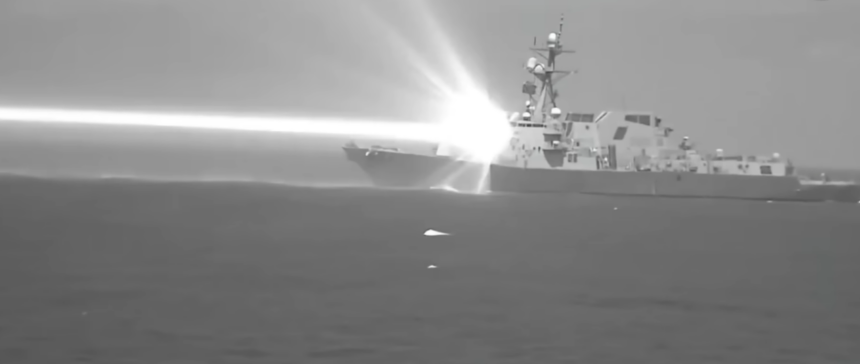
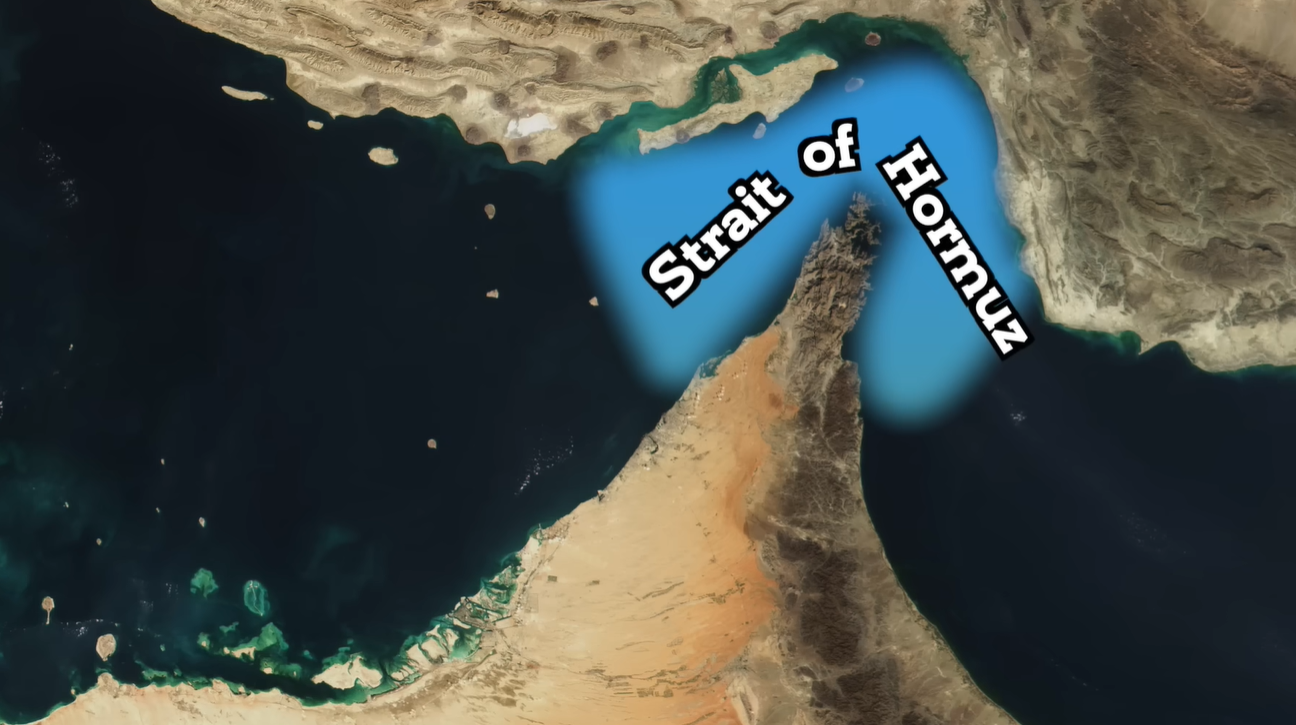
The US Department of War has confirmed the deployment of laser weapons in the Strait of Hormuz, according to New York Post. The infrared directed-energy laser weapons will intercept Iranian drones and cruise missiles. This development will allow US forces to neutralize aerial threats at a fraction of the cost compared to traditional kinetic missile systems.
The deployment is driven by the fact that firing a traditional multimillion-dollar kinetic missile interceptor to intercept a $20,000 Iranian Shahed drone was proving to be economically unsustainable. Additionally, there has been a $500 million to $711 million increase in defence spending on “war-ready” production contracts. The military has also entered into a $465 million contract with AeroVironment for the production of defensive laser hardware.
What laser weapons are being deployed?
The weapons feature two primary tiers of directed-energy weapons (DEW) designed for naval environments. These weapons operate through generators or battery packs that convert energy into concentrated beams of light.
The High-Energy Laser with Integrated Optical Dazzler and Surveillance (HELIOS) is a 60-kilowatt high-energy fiber laser installed aboard Navy destroyers. This system will focus an invisible infrared beam on the target, causing it to rapidly heat up until it melts or explodes. The Optical Dazzling Interdictor, Navy (ODIN), is a lower-power weapon. It is designed to blind the electro-optical and infrared sensors of hostile weapons, disrupting their guidance systems.
Military experts note that configuring and aiming these high-tech systems is reportedly being performed using modified Xbox video game controllers.
Escalating tensions with Iran
The deployment of laser weapons comes amid Iran’s use of complex electro-optical seekers being installed on its missiles and drones. This camera-based guidance system bypasses satellite navigation and is not disrupted by traditional US electronic GPS-jamming systems.
Moreover, Iran has recently shot down U.S. MQ-1 and MQ-9 Reaper drones in the region. In response, the US military destroyed two Iranian boats that were sent to seize an American unmanned surveillance vessel. Moreover, Major General Yahya Rahim Safavi, the military advisor to Iran’s Supreme Leader Ayatollah Mojtaba Khamenei, has issued warnings to the US. He maintained that if the US launched further strikes, Iran would expand the conflict beyond the Persian Gulf and the Red Sea.
Defense analysts note that using laser weapons significantly alters military logistics. Lasers use electricity rather than physical munitions. Consequently, warships can now operate defensively without exhausting physical ammunition stockpiles in situations involving prolonged swarm attacks.
Till now, laser weapons had only been deployed against technological assets and cartels along the US Southern border. They have not been previously used in the Middle East.






Six months late in my opinion.
I guess the eggheads at Dahlgreen, VA couldn’t get their rail gun project off the test range. It would have been far superior to lasers. It would eliminate the need for powder magazines completely, while the impact would be total devastation to any target. Speed plus mass equals obliteration. With a laser, you’ve got to hold on that target until it cooks. Good luck with that while under enemy fire!
That photo isn’t a laser it’s a search light.