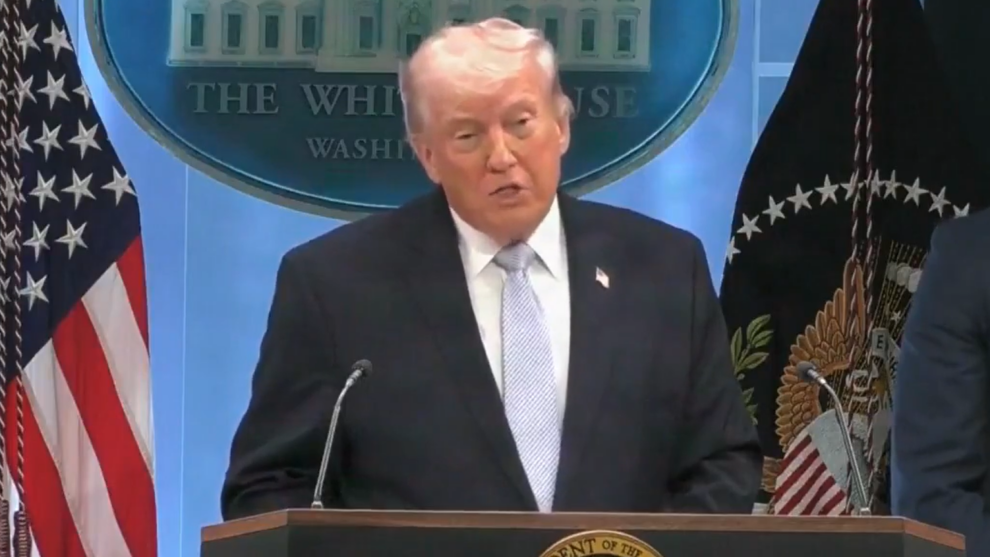
US President Donald Trump warned “a whole civilization will die” in Iran if the country does not heed his midnight deadline to open the Strait of Hormuz, as Tehran reported US-Israeli attacks on its infrastructure were already underway.
Speaking in Budapest, Vice President JD Vance said the United States has “tools in our toolkit that we so far haven’t decided to use” against Iran, without explaining further.
The White House later denied that Vance was alluding to nuclear weapons, while Press Secretary Karoline Leavitt said in a statement to AFP that “only the President knows where things stand and what he will do”.
The statements came as Iran reported the United States and Israel had begun striking key infrastructure, with Israeli Prime Minister Benjamin Netanyahu confirming attacks on railways and bridges he said were “used by the Revolutionary Guards”.
Trump had initially vowed to carry out the “complete demolition” of Iran’s critical infrastructure, particularly bridges and power plants, only if a deal was not reached.
But hours before the deadline, the Israeli military said it had already completed a broad wave of strikes targeting “infrastructure sites” across Iran.
Writing on Truth Social, Trump elevated his ultimatum for Iran, stating that “a whole civilization will die tonight, never to be brought back again. I don’t want that to happen, but it probably will”, if the country did not make a deal.
It was not clear exactly what he meant or by what means he intended to carry out the threat.
Iran’s Revolutionary Guards warned they would deprive the United States and its allies of oil and gas if Washington crossed Tehran’s “red lines”.
Both Trump and Iran have said previously that a proposal touted by international mediators for a 45-day ceasefire was not yet ready.
Infrastructure attacks reported by Iranian authorities Tuesday included a US-Israeli strike on a bridge outside the city of Qom and another on a rail bridge in central Iran that killed two people.
Regional authorities also said a US-Israeli strike shut down a key highway in northern Iran connecting the city of Tabriz with Tehran.
The Mizan news agency additionally reported a strike on railway tracks in Karaj, outside Tehran.
– Death ‘not a joke’ –
University student Metanat, whose classmate was killed two weeks ago in an attack, told AFP that she felt “terrified and so should everyone else in the country”.
The 27-year-old, who declined to give her last name, said as far as Trump’s ultimatums were concerned, “some people think they are a joke”, but “death is not a joke”.
The UN’s rights chief decried the “incendiary rhetoric” in the Middle East war on Tuesday, warning that deliberate attacks on civilians and civilian infrastructure was “a war crime”.
At the UN Security Council, Russia and China vetoed a resolution on reopening the Strait of Hormuz, a text already diluted from the green light Gulf states had sought to use force to protect the key shipping lane.
Iran has effectively blocked the waterway — through which a fifth of the world’s oil normally flows — since the start of the war on February 28, driving up global energy prices.
Iranian pensioner Morteza Hamidi said that among many emotions, he felt “gloomy for the future of the country after the war”.
The 62-year-old added that he had seen Trump back down too many times to take his words seriously: “We are now numb to his threats”.
– Other strikes –
Apart from the infrastructure attacks, strikes were reported on Kharg island, a critical hub for the Iranian oil industry, according to Iran’s Mehr news agency, although US media said the attacks were against military targets.
Earlier in the day a series of explosions was heard across Tehran, and Iranian media reported that 18 people, including two children, were killed in strikes in neighbouring Alborz province.
US-Israeli strikes also “completely destroyed” the capital’s Rafi-Nia synagogue, local media reported. The Israeli army later expressed regret for the “collateral damage”, saying it had been targeting a senior military commander, not the house of worship.
Overnight, attacks on Saudi Arabia hit a petrochemical complex in a sprawling industrial area in the eastern city of Jubail, a witness who requested anonymity told AFP, hours after similar installations in Iran were struck.
On the war’s Lebanese front, the Israeli military said it had completed deployment of ground troops along a “defence line” in the south, where it is fighting Iran-backed Hezbollah.
It additionally urged all vessels in the maritime zone off the country’s south to immediately head north of the city of Tyre, warning that it would operate in the area.

Add Comment