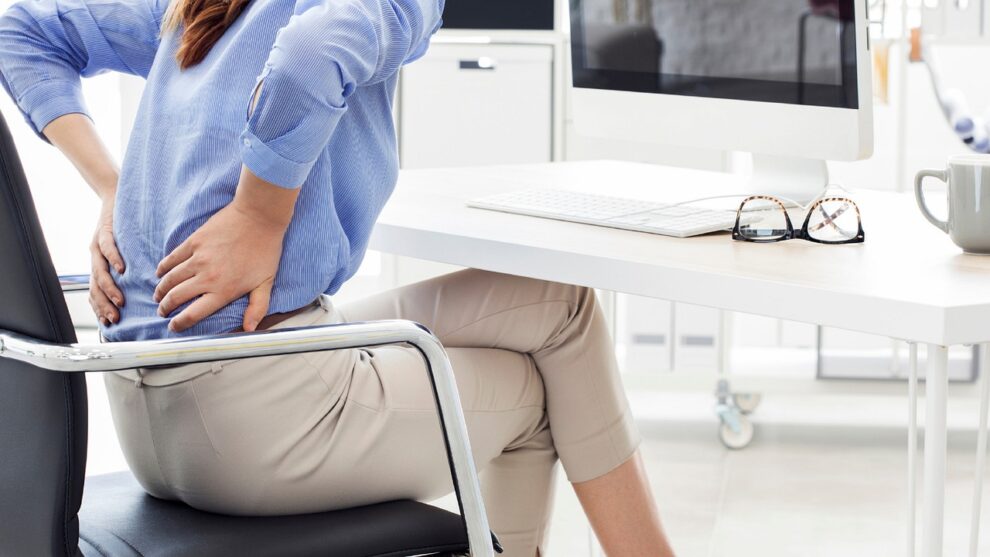
Eight hours in a chair does things to your body. Your lower back stiffens. Your neck aches. Your hips forget how to move. A few minutes of the right stretches can undo most of the damage.
How a Sedentary Lifestyle Creates Muscle Imbalance
Sitting puts certain muscles to sleep while others work overtime. Your glutes go quiet. Your hip flexors shorten. Your chest tightens and your upper back stretches thin. Over time, this creates muscle imbalance. The parts of your body that should carry the load stop doing their job.
Your body works like a chain. When one link gets stuck, the ones above and below strain to cover. Sitting jams the chain at your hips, and pain spreads from there.
Why Tight Hip Flexors Cause Lower Back Pain
Your hip flexors run from your spine to your thigh bone. Every hour you sit, they shorten a little more. When these muscles get tight, they pull your pelvis into a forward tilt. That tilt puts constant pressure on your lumbar spine. Most people blame their back, but the real cause sits at the front of their hips.
The stiffness builds so slowly you barely notice until tying your shoes feels like a chore.
The Half-Kneeling Hip Flexor Stretch
Drop one knee to the floor and place the other foot out in front. Keep your torso tall. Press your hips forward until you feel a stretch across the front of your back leg. Hold for 30 seconds, then switch sides.
For a deeper stretch, lean slightly away from the kneeling side. You will feel the pull along your hip and waist. Keep it small and controlled. Do this twice a day and your hips will loosen within a week.
Glute Activation to Support Your Core
Strong glutes protect your lower back. But hours of sitting train them to shut off. When that happens, your hamstrings and lower back try to cover the gap. Pain follows.
Glute bridges fix this. Lie on your back with your knees bent and feet flat. Press through your heels and lift your hips toward the ceiling. Squeeze hard at the top for two seconds, then lower down. Aim for 15 reps. If you feel this in your back instead of your glutes, tuck your pelvis before you lift.
If pain sticks around despite these stretches, a physical therapy parker provider can find what is driving it and build a plan for your body.
Spinal Mobility and Thoracic Rotation
Your mid-back is built to twist and bend. Sitting hunched at a desk locks it in place. When your thoracic spine cannot rotate, your neck and lower back try to make up for it. That is how you end up sore in two places at once.
Try a seated rotation stretch. Sit on the floor with legs crossed. Place one hand behind your head. Rotate toward the opposite knee, leading with your elbow. Breathe out as you turn. Do eight reps per side.
A lying version works well too. Lie on your side with knees stacked. Open your top arm wide like a book and follow it with your eyes. Let your chest open fully. This one feels great in the morning.
Forward Head Posture and Neck Tension
For every inch your head drifts forward, it adds about 10 pounds of strain on your neck. Desk workers carry their heads in front of their spine for hours without knowing it. The muscles at the base of the skull and across the upper back take the hit.
Chin tucks are the simplest fix. Sit tall and pull your chin straight back, like making a double chin on purpose. Hold five seconds. Repeat 10 times. This builds strength in the deep neck muscles that hold your head in place.
Chest Opener for Rounded Shoulders
Typing pulls your shoulders forward and caves your chest in. Over time, the muscles across your chest get short and tight. Your upper back rounds to match. This puts stress on your shoulder joints and can cause pinching between your shoulder blades.
Stand in a doorway and place your forearms on each side of the frame. Step forward and let your chest stretch open. Hold for 20 to 30 seconds. Pair this with chin tucks. One pulls your head back, the other pulls your shoulders back. Together they counter hours of hunching.
Movement Breaks and Posture Correction
None of these stretches matter much if you only do them once. The real fix is breaking up long hours of sitting with short movement breaks. Set a timer for every 45 minutes. Stand up. Walk for a minute. Do one or two of the stretches above.
Your body was not designed to hold one position all day. It adapts fast when you give it the right signals. A few minutes of the right work, spread across your day, can erase years of desk damage. Start with one stretch. Add another next week. Small, steady changes are all it takes.

Add Comment