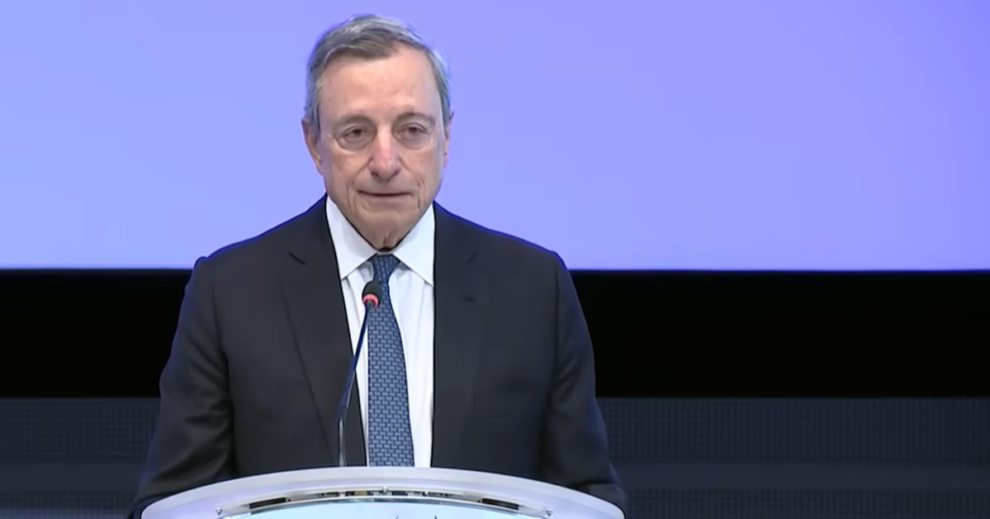
Europe needs to bridge “old divisions” to become a “genuine power” — or risk remaining “subordinated” to the United States and China, former European Central Bank chief Mario Draghi warned Monday.
Draghi, who authored a landmark 2024 report on the EU economy, warned that the 27-nation European Union had to get its act together to survive under a “now defunct global order”.
“Of all those now caught between the US and China, Europeans alone have the option to become a genuine power themselves,” the ex-Italian prime minister said in a speech at a university in Leuven, Belgium.
“So we must decide: do we remain merely a large market, subject to the priorities of others? Or do we take the steps necessary to become one power?” he asked.
Draghi is invited to join an informal gathering of European leaders focusing on strengthening Europe’s competitiveness on February 12 in Alden, Belgium.
The meeting is supposed to steer Brussels’ reform agenda over the coming months. Part of this will involve implementing more of the hundreds of recommendations from Draghi’s 400-page report — few of which have become reality nearly 18 months on.
On Monday the 78-year-old Italian, who received an honorary doctorate from the KU Leuven university, did not go into details but pointed the way.
Europe was caught between a tariff-imposing United States that threatened its territorial interests and a China willing to exploit its control of global supply chains for leverage, he said.
“This is a future in which Europe risks becoming subordinated, divided, and deindustrialised — at once,” Draghi cautioned.
“And a Europe that cannot defend its interests will not preserve its values for long,” he said, warning US President Donald Trump’s administration had made “clear” it sees “European political fragmentation as serving its interests”.
To avoid that, he said the EU had to diversify trade relations by concluding deals with like-minded countries and move from a loose confederation to a European federation.
“Where Europe has federated — on trade, on competition, on the single market, on monetary policy — we are respected as a power and negotiate as one,” he said.
“Where we have not — on defence, on industrial policy, on foreign affairs — we are treated as a loose assembly of middle-sized states, to be divided and dealt with accordingly.”
Integration could proceed at different speeds, with only some countries initially signing up to some initiatives, but was necessary, he argued.
“We are all in the same position of vulnerability, whether we see it yet or not,” Draghi said. “The old divisions that paralysed us have been overtaken by a common threat.”

Add Comment