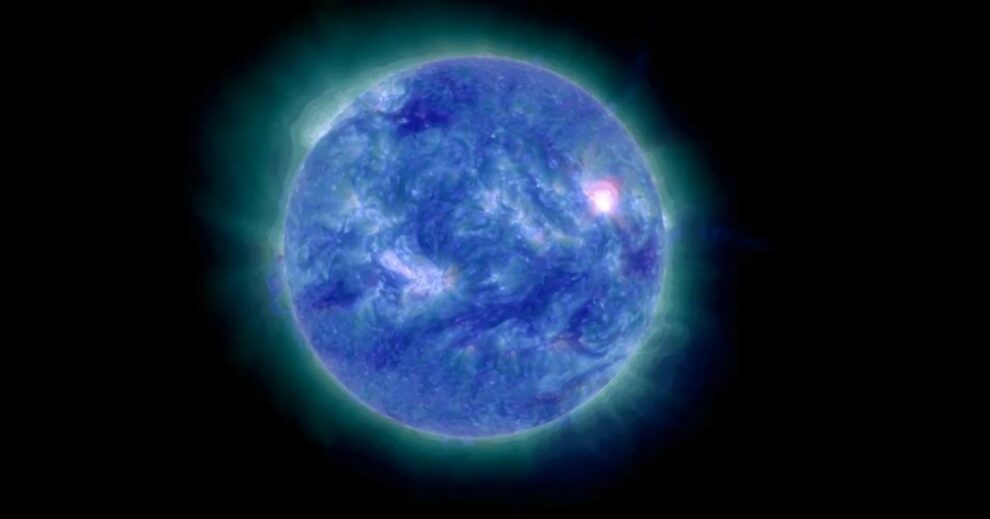
The Sun generated at least two intense solar flares that sent plasma toward Earth, which could affect radio signals and cause stunning Northern Lights displays across the northern U.S. this week, Fox Weather reported.
SWPC issued a Geomagnetic Storm Watch due to strong solar flares this week, rating the expected storm as moderate
According to the NOAA’s Space Weather Prediction Center (SWPC) aurora forecast, the Northern Lights could be visible from northern Idaho to Michigan’s Upper Peninsula on Monday night.
The SWPC issued a Geomagnetic Storm Watch on Saturday after satellites tracking the Sun detected a coronal mass ejection (CME) that launched on Friday. The main effects from this burst of plasma were expected to hit Earth on Sunday and Monday. The SWPC rated the expected geomagnetic storm as a Level 2, or moderate, on a 5-point scale for Monday.
Here are two views of today's solar flare toggling between a single wavelength (FE 131) and an RGB blend of 3 wavelengths measured by the Solar Ultraviolet Imager (#SUVI) flying on #GOESEast. https://t.co/I56zAtGV9t The flare peaked at 0635 UTC (1:35 CDT) on May 6 per @NWSSWPC. pic.twitter.com/ncK7yXkrs0
— UW-Madison CIMSS (@UWCIMSS) May 6, 2024
Besides the coronal mass ejection (CME) possibly creating aurora displays, the SWPC noted that it has been monitoring a particularly active area on the Sun, which has been producing strong and moderate solar flares since late April.
The SWPC reported multiple intense X-class flares on Sunday, along with several M-class flares over the weekend. X-class flares are the most powerful, while M-class flares are the second-most intense.
Sunspot region 3663 generates solar flares, raising the risk of radio blackouts and auroras
Auroras happen when charged particles from the Sun collide with Earth’s atmosphere, resulting in the dazzling Northern and Southern Lights.
Solar flares usually happen in active regions of the Sun, often linked to clusters of sunspots. The recent flare activity is originating from an area of the Sun designated as 3663. They are bursts of electromagnetic radiation that can lead to high-frequency radio blackouts and pose risks to space launches and satellites orbiting Earth.
However, most people don’t need to worry, as these energetic particles don’t penetrate far enough into Earth’s atmosphere to impact the public, according to Fox Weather.
“Region 3663 is the largest and most complex sunspot region on the disk, and has produced a total of 14 M-flares and three X-flares since it emerged on April 30,” according to the SWPC.
According to NOAA’s space weather forecasters, more flares are expected from this active region in the coming week.

Add Comment