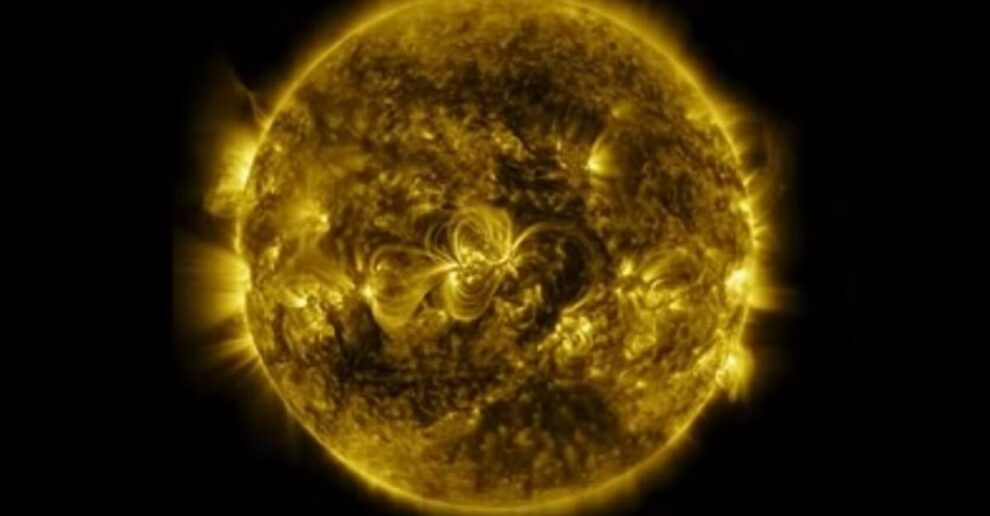
Solar flare warnings have been issued as sunspot numbers reach a 23-year high, Newsweek reported. A massive sunspot, AR3780, is growing and crackling with activity, posing a threat of powerful solar flares directed toward Earth. This sunspot is one of many observed during this peak in sunspot frequency.
July 2024 sees average sunspot numbers of 196.5, Northern Lights likely to reappear this weekend
According to spaceweather.com, the average number of sunspots in July 2024 was 196.5. This data comes from the Royal Observatory of Belgium’s Solar Influences Data Analysis Center. This follows a week of “photographic displays” of the Northern Lights in North America, which are likely to occur again this weekend.
“The sun has been having bursts of activity typical of being near solar maximum and likely to last for a year or two until it generally goes down when there are less sunspots,” Martin Connors, a professor of space science and physics at Canada’s Athabasca University, told Newsweek.
Currently, on the southeastern side of the sun, the sunspot will soon move to the side facing Earth. This will allow us to measure its size more accurately, but it will also put us at risk for solar flares and coronal mass ejections (CMEs).
Scientists say we can expect more Northern Lights in the coming weeks and months, including this weekend, according to Forbes. This is because July 2024 saw more sunspots on the sun than any time since December 2001. The 2001 sunspot peak occurred just a few years before the 2003 Halloween storms. An X45 solar flare and G5 geomagnetic storms were recorded during these storms, causing power outages in Sweden.
How solar activity influences Earth and the Northern Lights
Sunspots are large magnetic disturbances on the sun’s surface, sometimes as big as Earth. NASA has been counting them daily since 1611, as they show how magnetically active the sun is. A solar flare is a powerful burst of radiation from the sun that travels at light speed, reaching Earth in just eight minutes. While solar flares can cause radio blackouts, they do not create auroras.
However, CMEs (coronal mass ejections) send magnetic fields and charged particles into the solar system at speeds of up to 1,900 miles (3,000 kilometers) per second. If they are heading towards Earth, they can trigger geomagnetic storms, which cause the Northern Lights. These CMEs can take a few days to reach Earth.
More powerful CMEs and solar flares have more extreme effects on Earth. For example, the G5 geomagnetic storm—the most severe type—on May 10 caused the Northern Lights to be visible across all 50 U.S. states. This storm was the strongest since 2003, occurring as the sun approaches its solar maximum.

Add Comment