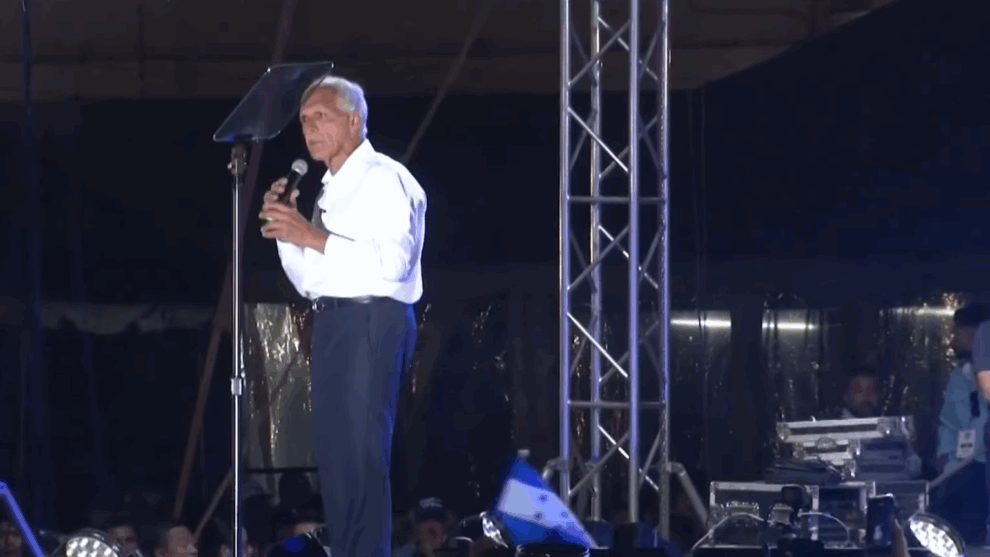
Conservative businessman Nasry Asfura was sworn in Tuesday as president of Honduras, two months after winning elections with vocal backing from US President Donald Trump.
The 67-year-old construction magnate was declared the winner of November’s vote by a razor-thin margin after Trump threatened to cut aid to Central America’s poorest country if his “friend” was defeated.
Taking his oath before Congress in the capital Tegucigalpa, Asfura vowed to “fight insecurity head on, have no doubt about that.”
He also made an appeal for unity after an election marred by allegations of fraud and a three-week wait for the results.
“We won’t get ahead through insults, revenge, or hatred,” he urged.
His win gives Trump another ally in Latin America after conservatives campaigning heavily on crime and corruption replaced leftists in Chile, Bolivia, Peru and Argentina.
Asfura, who is of Palestinian descent, defeated TV star and fellow conservative Salvador Nasralla by 40.1 percent of the vote to 39.5 percent, according to the official results.
After his win, he traveled to the United States to meet with Secretary of State Marco Rubio and also visited Israeli Prime Minister Benjamin Netanyahu.
China, migration
Tegucigalpa’s ties with Beijing — the outgoing left-wing government switched its support from Taiwan to China in 2023 — were at the heart of the election.
Trump has been pressuring countries in Washington’s backyard to choose between close ties with Washington or Beijing.
The US ouster of Venezuelan leader Nicolas Maduro, an ally of China, was widely seen as a warning to other Latin American countries to pick their camp.
Asfura has said he is considering switching ties back from China to the self-ruled island of Taiwan.
The fate of around two million Hondurans living in the United States, many without legal status, also hangs in the balance.
Asfura has urged Trump to reinstate their Temporary Protected Status (TPS), a program that protected some 60,000 Hondurans from deportation.
– Blighted by extortion –
Remittances from migrants represent a third of Honduras’s GDP.
Rubio, however, said Washington was looking forward to working with Asfura to “end illegal immigration to the United States.”
Asfura has promised to crack down on drug trafficking and to go after powerful transnational gangs such as Barrio 18 and MS-13, who extort businesses big and small.
“Extortion is what’s holding back anyone who owns a business or works independently, and if you don’t pay, they kill you,” Daniel Santos, a 64-year-old taxi driver, told AFP.
Asfura has however ruled out extending a state of emergency imposed by his left-wing predecessor Xiomara Castro, which was modelled on the brutal anti-gang war of neighboring El Salvador.
On the eve of the election, Trump in a surprise move pardoned former Honduran president Juan Orlando Hernandez, from Asfura’s party, who was serving a 45-year prison sentence in the United States for drug trafficking.
Hernandez was convicted of helping to smuggle 400 tons of cocaine into the United States.
Trump’s decision to pardon him, even as US forces were blowing up alleged drug boats in the Caribbean and tightening the noose on Venezuela’s ousted leader Nicolas Maduro, whom Washington accuses of drug trafficking, drew heavy criticism.
Asfura has distanced himself from Hernandez and held phone talks with the leftist authoritarian president of nearby Nicaragua, Daniel Ortega, whom Washington calls a “dictator.”
Asfura justified the call as part of his pursuit of “peace in the region.”

Add Comment