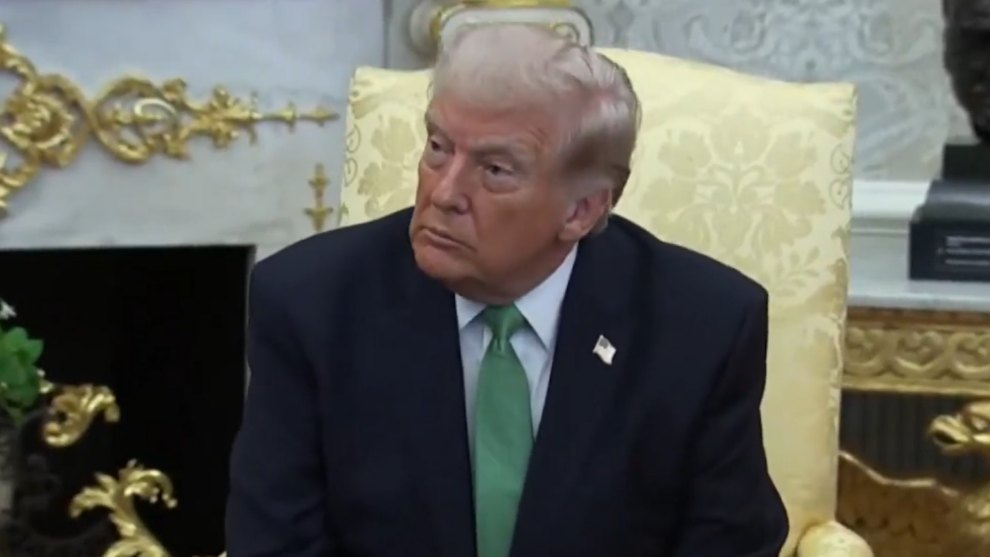
US President Donald Trump warned Iran on Thursday to get serious about talks to end the Middle East war “before it is too late”, as Iranian state media said Tehran had already responded to Washington’s overture and was awaiting a reply.
Trump’s envoy Steve Witkoff told a cabinet meeting in Washington there were “strong signs” that Tehran was ready to negotiate an end to the fighting, despite its cool public response to a 15-point American peace plan shown to Iran by Pakistani intermediaries.
“We will see where things lead, and if we can convince Iran that this is the inflection point with no good alternatives for them, other than more death and destruction,” Witkoff said.
The exact contents of the US plan, conveyed to Iran via Pakistan according to Pakistani officials, are not public, but the Iranian news agency Tasnim said: “Iran’s response to the 15 points proposed by the US was officially sent last night through intermediaries, and Iran is awaiting the other side’s response.”
The Tasnim report, citing an unnamed official, said Iran’s reply called for an end to US and Israeli attacks on Iran and also on Tehran-backed groups elsewhere in the region — an implicit reference to Lebanon’s Hezbollah, among others. War reparations should be paid and Iran’s “sovereignty” over the Strait of Hormuz be respected.
Pakistan confirmed Thursday it was facilitating “US-Iran indirect talks” by relaying messages — and that a 15-point American plan was being “deliberated upon” by Tehran.
– ‘No turning back’ –
“They better get serious soon, before it is too late, because once that happens, there is NO TURNING BACK, and it won’t be pretty!” Trump warned on social media. Later, at the US cabinet meeting, he said Iran had allowed 10 oil tankers passage through the Strait of Hormuz as a “present” to show it was serious about talks.
Iran says it has blocked the vital shipping lane to all but “non-hostile” vessels.
In response to a reporter’s question, Trump also said the United States might take control of Iran’s oil, comparing it to the deal Washington made with Venezuela after toppling Nicolas Maduro. “It’s an option,” he said.
Iran’s foreign minister Abbas Araghchi had denied on Wednesday that any negotiations had begun with Trump’s administration — but did concede messages were being exchanged through “friendly countries”.
Pakistani Foreign Minister Ishaq Dar said “brotherly countries” Turkey, Egypt and others were also supporting the mediation process.
– Conflict spreads east –
Under near-daily bombardment since February 28, Iran was hit by a new wave of Israeli strikes Thursday — one of which Israel said had “blown up and eliminated” the Guards’ naval commander, Alireza Tangsiri, and several senior officers.
Defence Minister Israel Katz blamed Tangsiri for throttling the vital Hormuz waterway.
The United States also endorsed the strike. Admiral Brad Cooper, commander of US Central Command (CENTCOM), said the killing “makes the region safer” and warned every Iranian serving in the Revolutionary Guards to return home to avoid suffering the same fate.
Iranian media reported US-Israeli attacks in the central cities of Isfahan and Shiraz, in Bandar Abbas in the south and Tabriz in the northwest — but also Mashhad and Birjand, towards the Afghan border in an area largely spared until now.
Off the coast from Bandar Abbas on Qeshm — the largest Iranian island in the Gulf — one local resident told AFP via Telegram he hoped the site would not be taken over by the military.
“The suffering of people, the poverty, and the political oppression have been getting worse every year,” said 42-year-old Sadeq.
“I don’t think war is the solution to these conditions, but ending it won’t change much for us either,” he said. “Our bigger war is with the Islamic republic.”
Fresh violence flared in the Gulf, with two killed by debris from an Iranian ballistic missile intercepted near Abu Dhabi, and drones fired at both Saudi Arabia and Kuwait.
Iran has targeted Gulf nations it accuses of serving as launchpads for US strikes, including hits on oil and gas sites. Crude prices had fallen since last week, but the wavering messages on talks saw oil prices jump again Thursday.

Add Comment