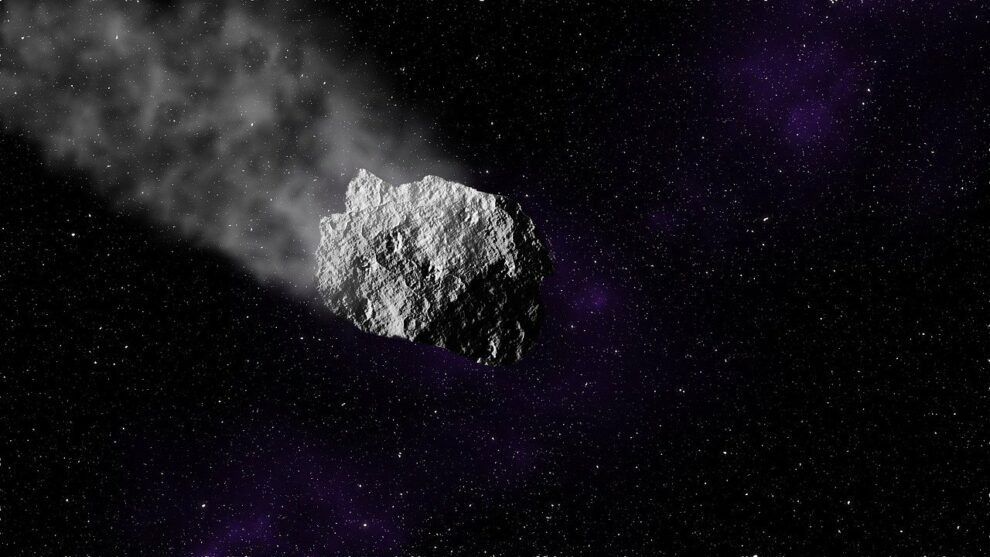
A massive asteroid, nicknamed the “planet killer,” will come closest to Earth in over a century this Thursday, LiveScience reported.
Planet killer asteroid to fly past Earth at 9pm BST on June 27
Officially named Asteroid (415029) 2011 UL21, it will pass by just after 9pm BST (4pm ET) on June 27, moving at nearly 26 kilometers per second.
NASA has labeled it a “potentially hazardous asteroid,” but it won’t pose any threat to Earth for at least the next thousand years. According to Space Reference, an open-source project, the asteroid is “comparable in size to Mount Everest” and will make an even closer approach in 2089.
“Asteroid (415029) 2011 UL21 will fly past Earth on 27 June, at 20:14 UTC (22:14 CEST),” the European Space Agency noted in an alert.
“At 2310 m across, it is larger than 99 per cent of all known near-Earth objects (NEOs), but it poses no risk to Earth and will pass by more than 17 times as far away as the Moon.”
The second asteroid, Asteroid 2024 MK, is slightly smaller, measuring between 122 and 256 meters in diameter. However, it will pass much closer to Earth than the first.
Astronomers first spotted Asteroid 2024 MK on June 16, 2024, and calculated that it will pass at 77% of the distance between the Moon and Earth.
Asteroid 2011 UL21 is likely at least 10 times smaller than the Vredefort asteroid, the largest space rock to ever hit Earth. It is also about five times smaller than the asteroid that wiped out the dinosaurs around 66 million years ago.
Here’s how to watch the close encounter live or view it through a telescope
You can watch a free live stream of the asteroid on the Virtual Telescope Project’s website at 9pm BST on Thursday. The stream will show the view from the Bellatrix Astronomical Observatory in Ceccano, Italy, Independent reported.
The asteroid will also be visible through a regular telescope on the nights of June 28 and 29, when it will appear at its brightest. This is one of two near-Earth asteroids passing by this week. The newly discovered Asteroid 2024 MK will zoom past on June 29.
You might also be able to spot the asteroid in the night sky with a decent telescope. It will be at its brightest on June 28 and June 29 and should be visible from the Northern Hemisphere if you know where to look. According to the Virtual Telescope Project, at its brightest, it will have a similar brightness to Proxima Centauri, the nearest known star to the sun.

Add Comment