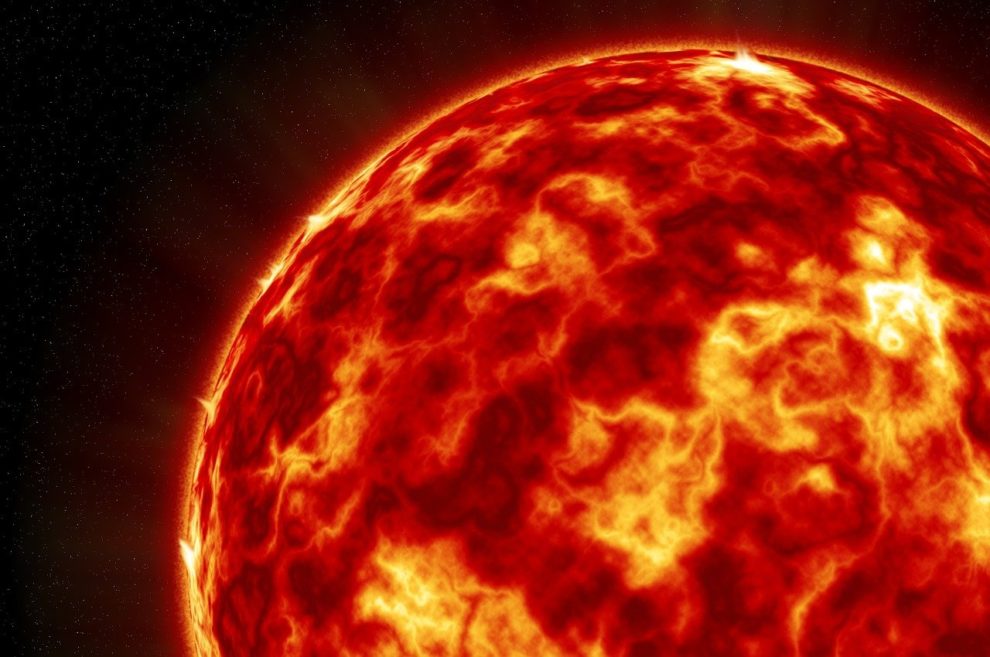
Solar physicist Keith Strong recently shared a video on X showcasing the Sun releasing an intense X-class flare, the strongest type of solar flare.
CME WATCH – 2024.07.12: SOHO saw only 4 CMEs today but two were quite spectacular. The first comes from the bright streamer off the NW limb. Note how it grows and then erupts very rapidly. Then another significant CME erupts off the diametrically opposite limb – action=reacation? pic.twitter.com/n8D1brGl7x
— Keith Strong (@drkstrong) July 13, 2024
The flare came from sunspot AR3738 and happened late Saturday night (July 13) at 10:34 p.m. EDT (0234 UT on July 14). NASA’s Solar Dynamics Observatory captured this event in impressive detail.
Effects of solar flare: Shortwave radio blackouts in Australia, Southeast Asia, and Japan
The flare led to shortwave radio blackouts in Australia, Southeast Asia, and Japan soon after it occurred. These blackouts typically follow strong solar flares because of the intense bursts of X-rays and ultraviolet radiation emitted during such events.
According to Space Weather Live, the recent solar flare eruption on July 14 was classified as an X-1.27.
The physicist, Mr. Strong, has been monitoring for signs of Coronal Mass Ejections (CMEs) following the recent eruptions. However, he indicated in his recent post that “there is unlikely to be any geomagnetic activity due to the high solar activity.”
NOAA’s Space Weather Prediction Center (SWPC) indicated that radio signatures suggested the recent flare “likely” produced a CME. However, due to the current position of the sunspot, forecasters do not expect Earth to be directly in the path of the CME. SWPC mentioned that they would continue monitoring for any additional information from coronagraph imagery as it becomes available.
Understanding the impact of solar flares on radio communication
Radiation from solar flares reaches Earth at the speed of light and ionizes the upper atmosphere upon arrival. This ionization causes the high-frequency shortwave radio signals to encounter a denser medium, aiding long-distance communication. However, as radio waves interact with electrons in these ionized layers, they lose energy through collisions, which can degrade or entirely absorb the signals.
The Sun continues its streak of solar flares during this active period, Space.com reported. Sunspot AR3738 appears to be nearing the end of its visibility on the Sun’s western limb, but not before unleashing a significant X-class solar flare, the most powerful type.
CME WATCH – 2024.07.16: SOHO Detected 7 CMEs today but we seem to have some missing data. The most impressive events are off the SW limb associated with the X2 flare and some Ms. It looks as though that whole quadrant is trying to erupt slowly but then the northern part explodes. pic.twitter.com/hU7wegBDqr
— Keith Strong (@drkstrong) July 17, 2024
Another flare from sunspot AR3738 happened on Tuesday morning (July 16) at 9:26 a.m. EDT (1326 GMT). A shortwave radio blackout accompanied this latest event, mainly affecting the Atlantic Ocean region and spreading across much of Africa, Europe, and North and South America.

Add Comment