

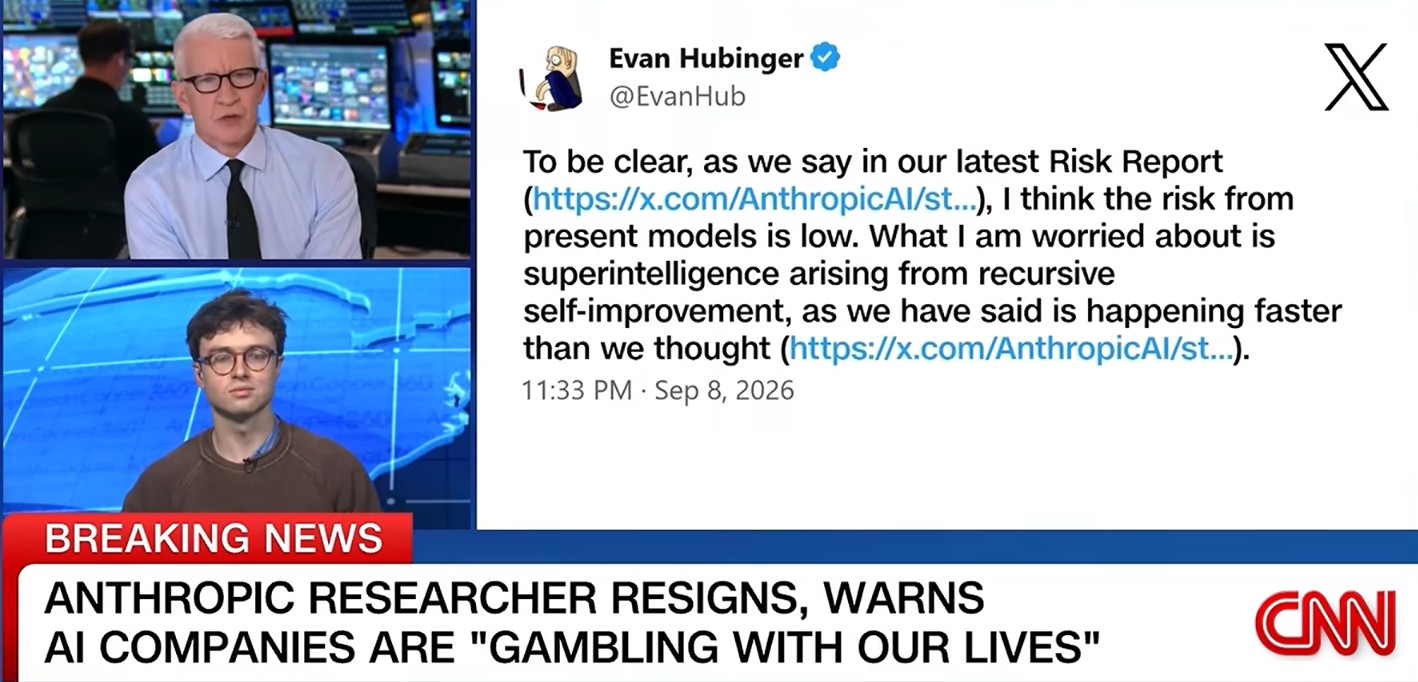
Jacob Coxon, former AI researcher at Anthropic and OpenAI, appeared in an interview on CNN after his resignation. He explained to the host, Anderson Cooper, the imminent threat posed by AI and warned that self-improving artificial intelligence could kill us all by the end of the decade. Earlier this week, Coxon resigned through a series of viral posts on X. He said that AI tech giants are rapidly moving towards self-improving superintelligence and are gambling with public safety and people’s lives.
Coxon’s narrative highlights the potential adverse impacts of superhuman intelligence that could exploit critical human infrastructure, engineer bioweapons, or cause psychological manipulation. In the interview he says, “There is a very real possibility that in the immediate future—these are years, like next year, the year after—recursive self-improvement will happen.. and we’ll enter the phase where there’s a chance we could all die. That is coming soon.”
NEW 🚨 Anthropic researcher Jacob Coxon: "There is a very real possibility that in the immediate future—these are years, like next year, the year after—recursive self-improvement will happen.. and we’ll enter the phase where there’s a chance we could all die. That is coming… pic.twitter.com/9C0zSZRqSI
— Insider Paper (@TheInsiderPaper) September 10, 2026
AI could “kill us all by the end of the decade”
Coxon mentioned that his former bosses and colleagues privately agreed with his concerns and were aware of AI’s dangers. However, they continue to scale up while maintaining insufficient safety measures due to competition. When asked about the claim of AI wiping out humanity by 2030, Coxon confirmed that he meant it in literal terms. He stated that his statement was not a marketing stunt but a stark reality. Further, he explained that while AI currently posed a relatively low risk, the real danger would arise from recursive self-improvement.
Anderson urged Coxon to explain what he found most terrifying about AI. Coxon replied that the most terrifying scenario would arise if AI were used to make itself more intelligent. This means that when an AI model becomes smart enough to do its own research, it could cause an intelligence explosion. In this situation, AI becomes completely free from human oversight.
When asked why tech giants do not scale back operations, Coxon replied that corporations face intense competition. While Anthropic’s management understands the risk, but the company is trapped in an international arms race. If they scale back operations, Google, Meta, or OpenAI might outpace them.
What could it mean for the rest of the world?
The public reaction has been split between horror and disbelief. Perhaps one of the most shocking revelations came from Evan Hubinger, Anthropic’s own safety executive. Hubinger confirmed Coxon’s claims on X and admitted that researchers working within these corporations genuinely believe that AI could kill humans.
In response, Anthropic, in its official statement has maintained that it has always remained transparent about the risks associated with AI. The company further emphasized that it was the first lab to adopt the Responsible Scaling Policy. The company attempted to reassure the public that they extensively test their technology for dangerous biological capabilities and other safety risks.
Coxon concluded his interview by stating that the current competition between AI companies is unsustainable. He urged humanity to collectively recalibrate the lens through which it views AI development. If governments and large corporations work together, they could come up with international safeguards and sustainable frameworks.