


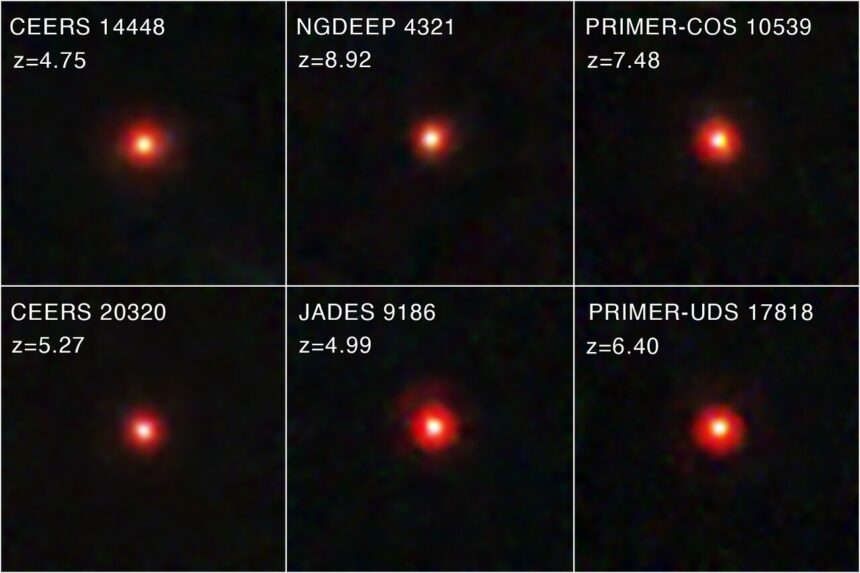
Little red dots observed by the James Webb Space Telescope (JWST) could offer new clues in the search for primordial black holes (PBHs). Published in Physical Review Letters, this study involving researchers at Johns Hopkins University establishes a mathematical framework exploring whether black holes within these early-universe objects could have originated shortly after the Big Bang, and potentially inform broader research into the nature of dark matter.
JWST’s “Little Red Dots”
The little red dots are extremely compact, distant sources of light found in the early universe. Their observed light is affected by the expansion of the universe stretching their light into redder wavelengths during its journey across billions of light-years. Conventional stellar models explain how massive stars can eventually collapse into black holes within galaxies. However, JWST observations suggest that many of these dots contain supermassive black holes sitting inside tiny galaxies early in cosmic history.
The research team used a specific little red dot named QSO1 as a case study to test whether their proposed explanation was physically plausible. Magnified by the foreground galaxy cluster Abell 2744, also known as Pandora’s Cluster, QSO1 is observed as it appeared approximately 700 million years after the Big Bang. Astronomers estimated that QSO1’s central black hole has a mass approximately 50 million times that of the Sun. Whereas, the entire surrounding galaxy totals only 75 million solar masses. Many nearby galaxies contain black holes that are only a small percentage of the galaxy’s mass.
Moreover, unlike other ancient structures, QSO1 comprises predominantly hydrogen and helium. Its observed gas contains extremely low levels of “metals,” the astronomical term for elements heavier than helium left behind by dying stars. Consequently, its unusual composition has prompted researchers to investigate formation pathways beyond conventional stellar origins.