


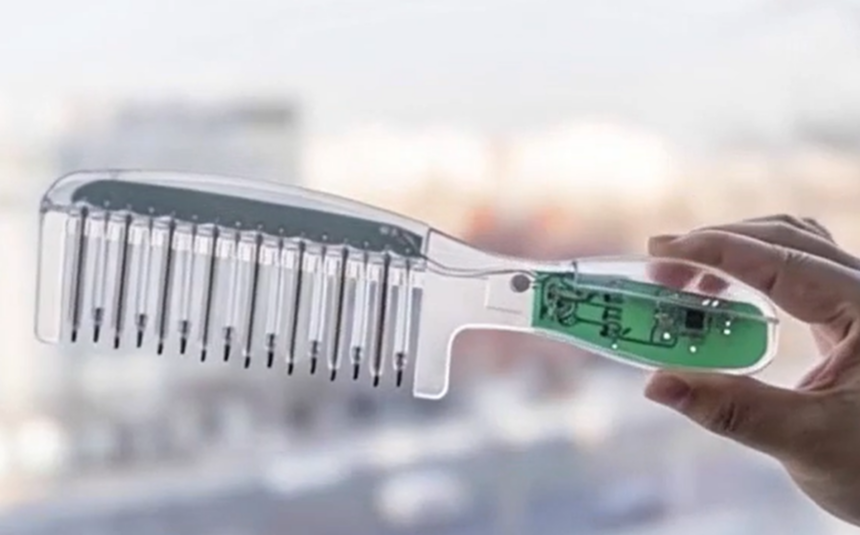
A team of researchers at Beihang University in Beijing has developed a comb-based treatment that achieved 97.85% hair regrowth in mice. The experimental bioelectric comb, called Detangle was tested on balding mice for 28 days and achieved remarkable results. The device outpaces standard medications for hair growth such as minoxidil and finasteride in preclinical animal trials.
How the Comb Works
Unlike standard laser combs and massagers, Detangle uses a combination of physical stimulation and deep molecular delivery. The comb has alternating teeth of different lengths that gently lift the scalp while delivering pulsed electric fields. This sophisticated design creates an electric field 2.63 times as strong as that produced by aligned teeth. Therefore, it penetrates approximately 9 times deeper into hair follicles than conventional treatments.
Moreover, shorter alternating teeth contain small drug-loading modules. The electrical pulses temporarily increase cell membrane permeability through a process known as electroporation. This allows therapeutic molecules to pass directly into follicle cells, thereby stimulating hair growth.
The comb delivers two experimental genetic therapies. These include a VEGFA plasmid, which encourages new blood vessel formation around follicles to boost nutrient and oxygen supply. Moreover, SRD5A2 siRNA suppresses the enzyme that produces dihydrotestosterone (DHT). This hormone is primarily responsible for shrinking follicles in pattern baldness.
Mouse Trial and Limitations
The study tested male mice with testosterone-induced hair loss. The Detangle treatment was applied once every three days, and results were compared against conventional remedies. The treatment resulted in 97.85% hair regrowth, this amounts to 70% more than minoxidil, and 50% more than finasteride.
Tissue analysis confirmed that the dual-delivery system successfully triggered angiogenesis (new blood vessel formation around hair roots) while suppressing local dihydrotestosterone (DHT) synthesis without systemic side effects. However, since mouse skin is considerably thinner than the human scalp, there are limitations to applying these findings to humans. Moreover, the mice’s hair loss was artificially induced in a laboratory, so the same results might not be observed in humans.