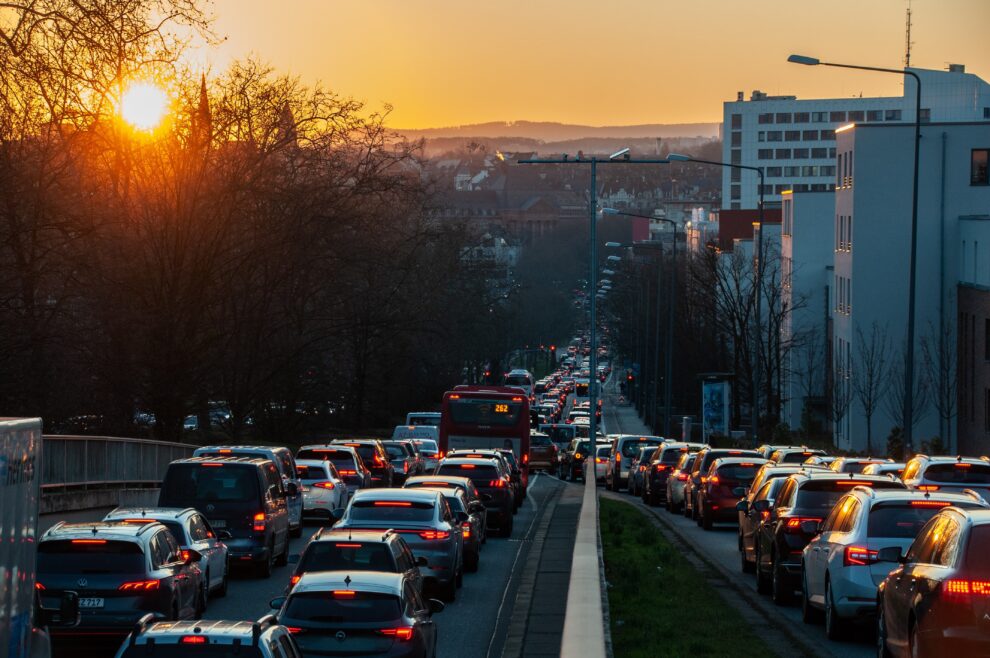
Traffic in Sacramento doesn’t look like Los Angeles.
But the numbers tell a different story.
Per capita, the region consistently ranks high for collisions. The mix is familiar: commuter congestion on I-5, bottlenecks along Business 80, suburban expansion feeding into urban corridors not designed for current volume. Add in delivery traffic, rideshare drivers, and aging infrastructure, and the margin for error narrows fast.
The result isn’t just more accidents.
It’s a growing economic strain on the people involved in them.
A City Growing Faster Than Its Roads
Sacramento has changed.
Population growth. Housing expansion. More commuters traveling longer distances into the capital. The road network hasn’t scaled at the same pace.
Morning traffic along I-5 now resembles patterns once limited to larger metros. Business 80—already constrained by design—absorbs overflow. Surface streets carry the rest.
Data from regional transportation agencies shows increased collision frequency in high-density corridors, particularly during peak commute windows. Rear-end crashes dominate. So do side-impact collisions at congested interchanges.
Short distances. Sudden stops.
Small moments. Big consequences.
For drivers, the risk is constant. For families, the impact doesn’t end at the crash scene.
The Real Cost Hits After the Tow Truck Leaves
A vehicle can be repaired.
A schedule can’t always be.
Lost workdays. Missed shifts. Reduced hours. For hourly workers, that translates directly into lost income. For small business owners, it means disruption to operations. Appointments get canceled. Deliveries are delayed. Clients move on.
Then come the bills.
Vehicle repairs have climbed sharply in recent years, driven by parts shortages and the complexity of modern systems. Rental car costs stretch into weeks when supply chains slow repairs. Insurance coverage often caps out before the process is complete.
The gap is paid out of pocket.
And for many households, there is no cushion.
Inside the Insurance “Black Box”
The claims process is no longer a conversation.
It’s an algorithm.
Insurance companies increasingly rely on software to evaluate claims. These systems pull from databases—past settlements, regional averages, injury categories—and generate a range. That range becomes the offer.
Industry insiders describe it as efficiency.
Consumer advocates describe it differently.
The software doesn’t see nuance. It doesn’t account for the individual circumstances behind a claim—the specific way a crash disrupted someone’s ability to work, care for family, or maintain financial stability.
It assigns value based on patterns.
And patterns favor lower payouts.
Adjusters still exist. But their discretion is narrower. The system guides the outcome.
The result is predictable.
Initial offers that fall short of real costs. Especially for injuries that don’t present immediately or aren’t visible on a scan.
The 72-Hour Window That Shapes Everything
The first three days after a crash matter more than most drivers realize.
This is when narratives form.
Statements are recorded. Reports are filed. Claims are opened. And, increasingly, offers are made.
Drivers are often contacted quickly—sometimes within hours. The tone is helpful. Cooperative.
But the timing isn’t accidental.
Early engagement allows insurers to lock in a version of events before all facts are known. Before symptoms emerge. Before full damage is assessed.
Agreeing too soon can limit what comes later.
If you say you’re fine, that statement can follow you. If you accept a settlement, it closes the door on additional compensation—even if costs rise or symptoms worsen.
The system rewards speed.
Drivers who move too fast often pay for it.
The Asymmetry of Power
A single driver enters the claims process with limited information.
Across the table is a corporation with data, legal teams, and automated systems calibrated to reduce payouts.
That imbalance shapes outcomes.
As insurers move toward AI-driven claims processing to minimize payouts, the role of a seasoned Sacramento car accident lawyer has shifted from optional support to a necessary counterweight.
Not because every case goes to court.
But because the presence of representation changes how claims are evaluated. It introduces scrutiny. Forces documentation. Slows the process just enough to ensure that decisions are based on complete information—not early assumptions.
In a system built for efficiency, friction can protect value.
What Gets Missed in the First Pass
Two categories routinely fall through the cracks.
Lost wages.
And non-economic damages.
Lost wages are straightforward on paper but complicated in practice. Not all income is salaried. Gig workers, contractors, and small business owners often struggle to prove disruption in a way that fits standardized models.
Non-economic damages—pain, reduced mobility, diminished quality of life—are even harder to quantify. Software models assign ranges. But those ranges rarely capture individual impact.
The gap between what’s offered and what’s experienced becomes the central tension of the claim.
Local Context Matters More Than Expected
Sacramento isn’t just another California city.
It has its own patterns.
Its own jury tendencies. Its own court timelines. Its own mix of urban and suburban drivers.
Statewide or national firms bring scale. But they don’t always bring local nuance.
Understanding how a collision on Business 80 is viewed compared to one on a rural connector road can influence how a case is framed. Knowing how local juries respond to specific types of evidence can shape strategy.
These aren’t abstract considerations.
They affect outcomes.
The Broader Impact
This isn’t just about individual claims.
It’s about system behavior.
If low settlements become the norm, the incentive to maintain safe driving practices weakens. If the cost of accidents is absorbed by victims rather than those at fault, accountability erodes.
Road safety isn’t just enforcement.
It’s a consequence.
When those consequences are diluted, risk increases.
A System at a Crossroads
Sacramento’s growth isn’t slowing.
Traffic density will continue to rise. So will the number of incidents tied to congestion, delayed reaction times, and infrastructure strain.
At the same time, insurance systems will continue to evolve—toward automation, toward cost control, toward standardized outcomes.
Drivers are caught between these trends.
More risk on the road.
Less flexibility in recovery.
The Bottom Line
A crash is a moment.
The aftermath is a process.
That process is increasingly complex, increasingly automated, and increasingly tilted toward efficiency over accuracy.
Drivers who treat it as routine often underestimate the stakes.
Those who approach it with caution—documenting early, questioning offers, understanding their rights—are better positioned to recover fully.
Not just physically.
But financially.
And in a city where traffic is only getting tighter, that distinction matters more every year.

Add Comment