

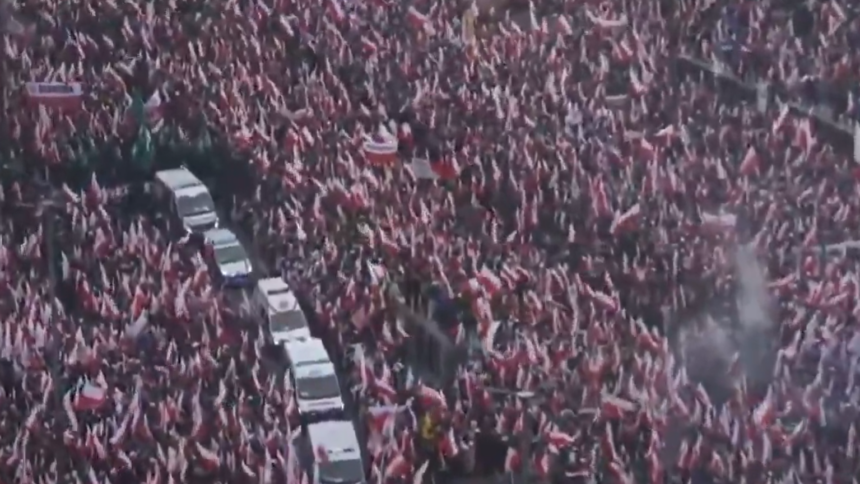
Tens of thousands of Polish nationalist sympathisers gathered in Warsaw Wednesday for an annual Independence Day March, just days after a deadly shooting spree in Krakow that shook the country.
The event is held each November 11 to commemorate the ending in 1918 of 123 years of partition by Russia, Prussia and Austria. While generally peaceful, some rallies in the past have been marred by clashes with police or counter-demonstrators.
Mariusz, a 52-year-old from the eastern city of Przemysl, told AFP he had to come to the march to “show his patriotism”.
Before the march, crowds gathered at an “independence town” of booths and tents in front of Warsaw’s cultural palace.
While some booths offered simple commemorative magnets with the Polish flag or the “Independence Day” slogan, others displayed Celtic crosses and extreme-right slogans.
Also on sale were and self-described “patriotic” books — including eurosceptic, anti-Ukrainian and anti-semitic titles.
Marching in chilly 3C temperatures, many people carried Polish flags and wore red and white, the national colours.
Police said they were ready to guarantee the safety of the event and reported eight arrests for posting “information intended to create a climate of threat”.
Marchers were banned from carrying weapons and concrete blocks were placed on certain roads in the city centre.
– High alert –
Warsaw is on high alert after deadly shootings in Poland’s second city of Krakow, which shocked the country of 38 million. A 24-year-old opened fire with a semi-automatic rifle in a packed market square on Saturday, killing six people and wounding 15 others before he was fatally wounded by police. The bodies of his parents and a sister were found at the family home.
On Tuesday, Justice Minister Waldemar Zurek said the killer had been interested in neo-Nazi Anders Behring Breivik, who killed 77 people in Norway in 2011.
Wednesday’s march also took place amid a political battle pitting Prime Minister Donald Tusk’s centrist government against the nationalist right over the country’s highest court — the Constitutional Tribunal.
The court’s legitimacy has been disputed for years because of controversial appointments made under previous right-wing governments.
The governing coalition says it wants to correct “political” reforms and appointments made by the far right, which it deems contrary to democratic standards.
But nationalists have accused Tusk of undermining constitutional order and right-wing protesters have been camping outside the tribunal for several weeks.
Last week, riot police moved onto the tribunal site to block access, and a judge appointed by the ruling majority announced she was assuming the court presidency role on an interim basis.
She suspended the sitting president, who is close to Karol Nawrocki, Poland’s conservative-nationalist president.
Nawrocki has attended the Independence Day March in the past in both his official capacity and as a private citizen.
The authorities feared political tensions could spill over into the streets and that some demonstrators may try to storm the Constitutional Tribunal.
Prime Minister Tusk called for unity on the national holiday.
“We have just gone through difficult days — our entire history is made up of happy days and trying days, but on November 11, all hearts are white and red,” he said.
Nawrocki said that Poles needed a “strong and effective state” in order to live “in freedom and sovereignty”.
The Polish state “does not exist today so that the political elites can grant themselves the right to manage citizens … against the will of the nation,” he added, alluding to the liberal government.
In addition to the march, masses, a military parade, and concerts are taking place in Warsaw, organised by the state authorities or by the centrist city hall of the capital.