


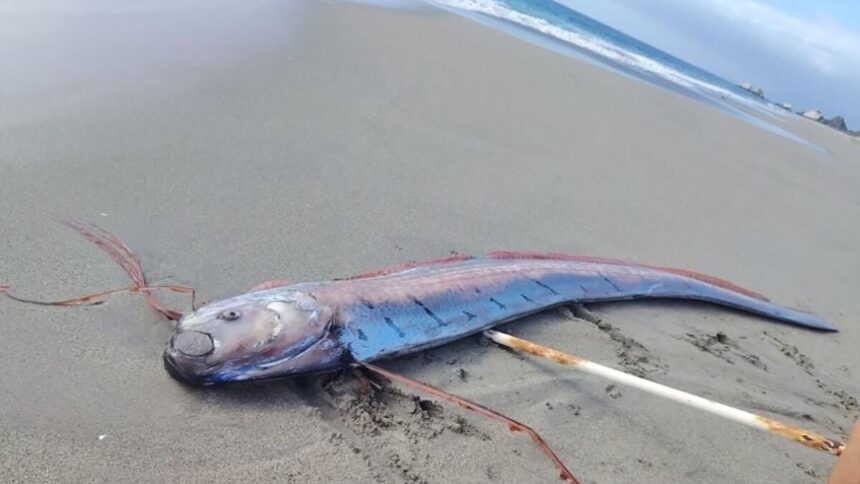
A rare oarfish, famously known as the “Doomsday fish,” washed ashore on a beach in Mejillones, northern Chile, this Tuesday. The 16-foot deep-sea fish, with its serpent-like appearance, sparked a wave of panic on social media. The doomsday fish has deep ties to ancient natural disaster folklore and is considered a bad omen.
Folklore of the Doomsday Fish
In Japanese mythology, the oarfish is called Ryugu no tsukai, which translates to the “Messenger from the Sea God’s Palace”. According to ancient theories, these fish intentionally rise to shallow waters to warn humanity of an impending catastrophe. They convey a direct warning from Namazu, a giant mythological catfish that lives in the mud beneath the earth. This catfish is responsible for causing earthquakes when it thrashes.
The myth gained renewed attention in connection with Japan’s devastating 2011 Tohoku earthquake and tsunami. In the preceding months, a dozen oarfish had washed ashore.
Moreover, oarfish can reach lengths of 26–50 feet and swim with an undulating, ribbon-like motion. They are believed to be the inspiration behind centuries of sailors’ tales about terrifying sea serpents. A historical log from March 1860 describes a 16-foot-long creature washing up on a Bermuda beach. It terrified locals, and sailors claimed that these beasts had massive, razor-sharp reptile teeth and actively destroyed ships.
Scientists Debunk the Doomsday Myth
In 2019, researchers at Tokai University analyzed 336 deep-sea fish strandings in Japan over several decades. The researchers then cross-referenced these events with earthquakes of magnitude 6.0 or higher. Scientists found no statistically significant correlation.
Researchers then looked to see whether the fish sightings occurred within 30 days before an earthquake and within roughly 60 miles (100 km) of its epicenter. They found only one case out of hundreds that met those criteria. The study noted that folklore surrounding the oarfish are a classic case of “illusory correlation”. This is a psychological phenomenon where humans perceive a relationship between two completely unrelated events because they stand out in our memory.
Scientists note that oarfish are mesopelagic creatures that typically reside at depths between 650 and 3,300 feet. They are poor swimmers despite their large size. They do not swim forward like eels; they are only able to drift vertically. Therefore, when strong deep-ocean currents or severe surface storms churn up the water, these fish easily get caught in the turbulence. Once an upwelling current pushes them out of the high-pressure deep ocean, they become disoriented and are unable to fight the breaking waves.
They also surface when they are injured and unable to swim properly. Therefore, scientists suggest that tthese fish are accidental visitors to shallow waters, rather than the bad omens described in folklore.