

North Korea’s state-run internet infrastructure has experienced blackouts for consecutive days. Virtually all websites using the country’s .kp top-level domain are experiencing widespread outages. This has cut off access from outside the country to North Korea’s official platforms and state media.
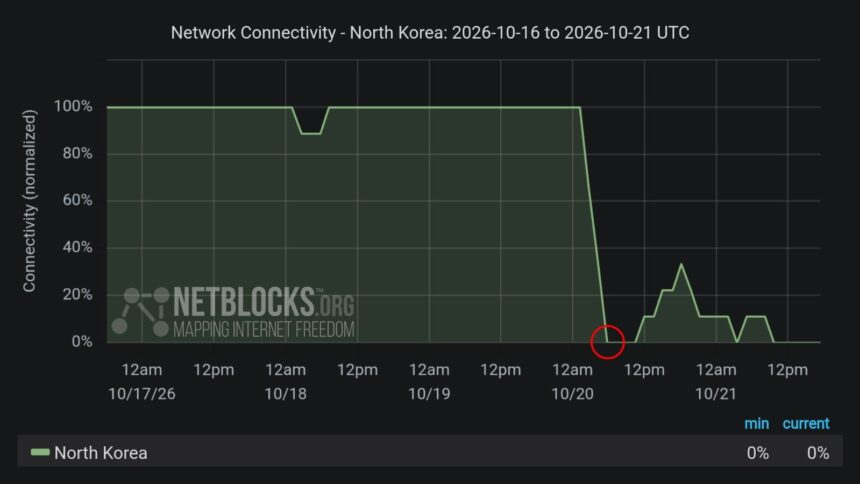
More than 40 official North Korean websites have been affected. These include major portals such as the Korean Central News Agency (KCNA), the Rodong Sinmun newspaper, and the Ministry of Foreign Affairs. The disruptions began on October 20, 2026, when network monitors tracked a near-total loss of connectivity lasting roughly six to eight hours. The outages continued into a second consecutive day with only brief bursts of connectivity recorded.
Timeline of the Digital Collapse
On October 20, 2026 network disruptions began around 11:00 AM KST. Network monitoring service Telecom Observer recorded a six-hour breakdown in North Korea’s Border Gateway Protocol (BGP) routing infrastructure. The next day, October 21, connectivity briefly returned, but servers quickly became unstable again.
Analysts are currently investigating whether this is a case of cyber warfare. North Korea’s internet has previously been targeted by retaliatory cyberattacks. For instance, in 2022, an independent American hacker named Alejandro Caceres took down the regime’s infrastructure through a retaliatory distributed denial-of-service (DDoS) attack. This was in response to North Korean spies targeting Western security researchers.
In contrast, several tech analysts are considering the possibility of a localized infrastructure failure. North Korea’s domestic power grid is unstable, while its internal routing servers rely primarily on aging hardware.
The “Kim Jong Un’s Death Rumor”
Shortly after the initial blackout, rumors of Kim Jong Un’s death began circulating online. Intelligence analysts speculated about whether an overwhelming flood of traffic from international monitors trying to reach KCNA triggered an organic Distributed Denial of Service (DDoS) attack.
However, independent network monitors like Telecom Observer dismissed this theory. They argued that a traffic overload affecting KCNA’s web servers would not, by itself, explain the wider disruption to the country’s routing infrastructure and DNS services the country’s Border Gateway Protocol (BGP) routing infrastructure and lower-level DNS name servers to stop responding entirely across more than 40 government domains.