



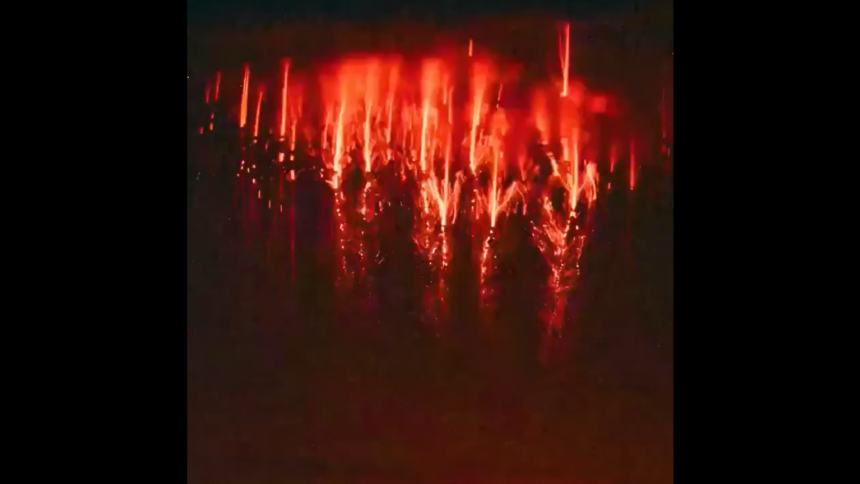
French photographer Florian Riou has captured the world’s attention by sharing viral images of massive red sprites over the French island of Corsica. Over the past two days, the images have sparked discussions on social media as people tried to make sense of the towering red sprites stretching upward. While the scene appeared to be straight out of a science fiction movie, capturing it required meticulous planning.
Riou photographed the display on September 16 from Montemaggiore, near Calvi. The storms responsible were much farther away, above the Barcelona region, roughly 500 to 700 kilometers from his position. He had studied forecasts for storms along the Spanish coast and checked viewing angles so the village would sit beneath any sprites that appeared. The result makes the red formations look as though they are hanging directly over the village, even though the storms that produced them were hundreds of kilometers away.
It's like an alien invasion: Rare red sprites photographed over France pic.twitter.com/XTVdhyghv0
— Insider Paper (@TheInsiderPaper) October 12, 2026
Getting a clear view also means choosing the right conditions. On his website, Riou explains that photographing sprites requires a cloud-free view toward the storm, with as little light pollution as possible. City lights and moonlight can make the faint flashes harder to capture. Even with a suitable location, the photographer still has to anticipate where they might appear.
What exactly are the red lights?
Despite looking like an alien invasion, the lights are a natural phenomenon: upper-atmospheric electrical discharges. Ordinary lightning strikes downward from clouds to the ground, but sprites appear to shoot upward from the tops of powerful thunderstorms.
When a powerful cloud-to-ground lightning strike deposits a positive electrical charge into the Earth, it causes an intense change in the electric field miles above the storm. This accelerates electrons in the upper atmosphere. Glowing molecular nitrogen produces the bright crimson color.
Sprites often resemble towering pillars or branching tendrils. They last only a few milliseconds, making them extremely difficult to see with the naked eye or capture on camera. They were first photographed in 1989.
[Source]











Really. I’ve taken video of thunderstorms and captured lightning for many years. Perhaps the exact conditions are met only in certain areas