

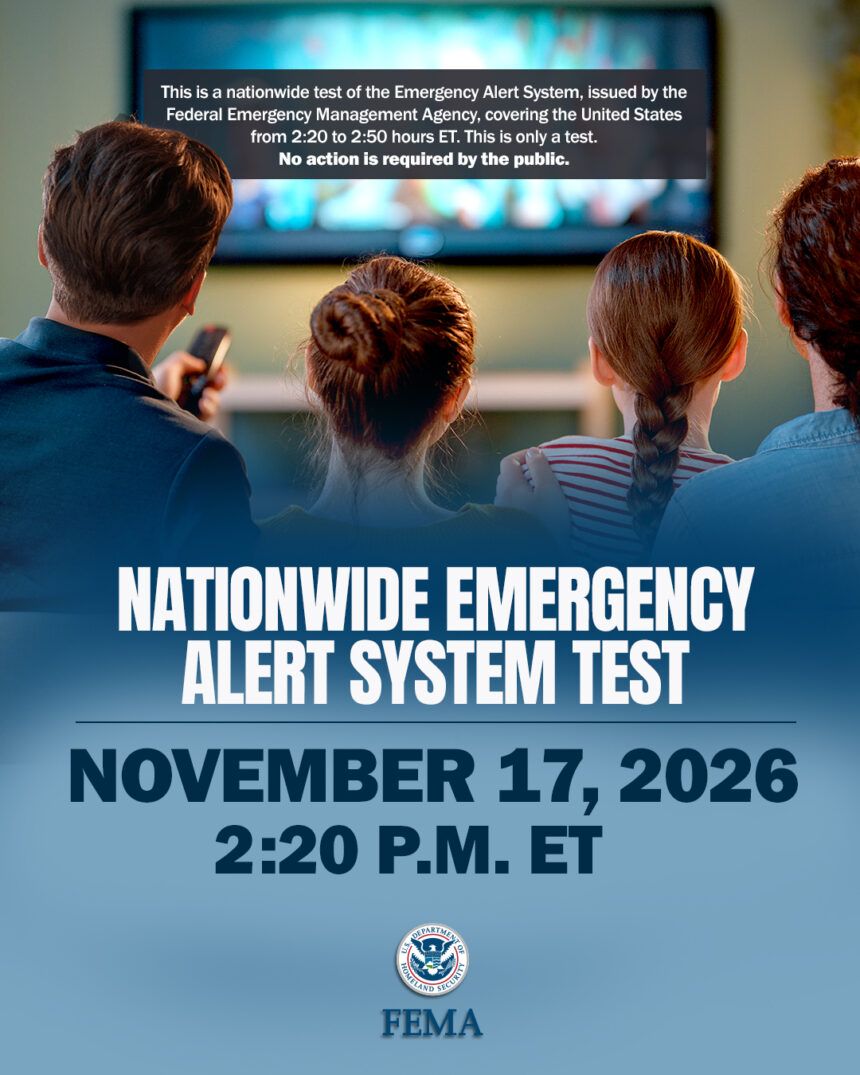
On Tuesday, November 17, 2026, at approximately 2:20 PM ET, participating television, radio, cable, satellite, and wireline video services across the United States will briefly interrupt normal programming. The US will test its emergency alert system. During the test, audiences may receive an audio announcement, an on-screen message, or both, depending on their provider.
Federal officials describe the broadcast as a routine technical test and emphasize that no action is required from the public. However, this nationwide Emergency Alert System (EAS) test is coming in a highly charged atmosphere. The announcement also provides an opportunity to explain how emergency alerts work and how households can prepare for disruptions.
“Federal law requires FEMA to conduct a nationwide EAS test at least once every three years. Routine tests help ensure the alert system is ready to provide timely information when it matters most.” – FEMA
Mechanics of the Test
The test is being overseen by the Federal Emergency Management Agency (FEMA) in coordination with the Federal Communications Commission (FCC). Although the test message specifies a window from 2:20 p.m. to 2:50 p.m. ET, the interruption to individual broadcasts is expected to last about one minute.
The test will assess whether participating communications providers can receive and relay a national emergency message effectively. Modern smartphones rely heavily on Wireless Emergency Alerts (WEA) driven by cellular networks. For this test, FEMA will transmit the message through the Integrated Public Alert and Warning System (IPAWS), using the Common Alerting Protocol (CAP). Participating providers will then relay the message to their audiences. The November 17 drill is designed to test the resiliency of this web, ensuring that if localized infrastructure or internet capabilities fail, a top-down emergency message can still successfully hop from station to station across the continent.
The timing of this test has been supercharged by recent announcement of the Pentagon’s internal defense plan, code-named FORTRESS. The plan is designed to ensure that the US military can keep its bases functional for at least 90 days completely independent of failing civilian infrastructure. The logistics of the plan rely on independent local power grids, portable nuclear reactors, and massive battery arrays.
The Global Context
This upcoming test is not an isolated event. Separately, several European governments have encouraged households to prepare for temporary disruptions to essential services.
In the UK, the government recently launched its “Be Ready” campaign. The campaign encourages households to prepare supplies for three days of disruption, including non-perishable food and bottled water. The objective is to help households manage temporary interruptions to essential services while emergency responders prioritize those who need additional support.
Meanwhile, Swedish authorities advise households to prepare to meet their basic needs for at least one week during a crisis or war. France, Ireland, and the Netherlands also promote preparedness for three days of disruption, according to the UK government. They have urged citizens to eliminate “just-in-time” dependency on commercial supply chains.