

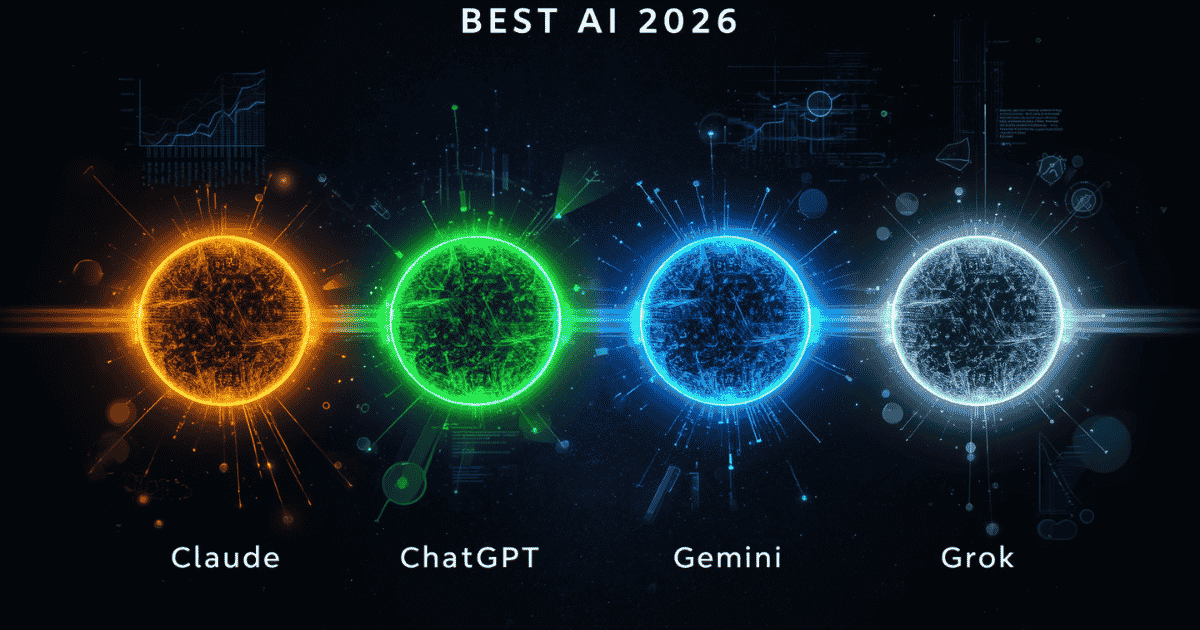
Claude, Gemini, Grok and ChatGPT can all write, code, analyze documents, search the web and answer complex questions. That makes choosing between them increasingly difficult.
There is also no credible way to declare one permanent winner. Performance can change when a company releases a new model, updates its tools or changes the usage limits attached to a subscription. Results also depend on the prompt, the type of work and whether features such as web search, extended reasoning or code execution are enabled.
The most accurate answer is therefore that no single chatbot is best at everything. Each platform has particular features that make it a better fit for certain users and workflows.
This comparison focuses on publicly documented capabilities available as of July 2026. It does not treat company benchmark claims as proof that one product is universally superior.
Quick comparison
| Your main priority | Strongest fit |
|---|---|
| Long documents and large amounts of context | Claude |
| Google Workspace and multimedia workflows | Gemini |
| Searching current discussions on X | Grok |
| A broad collection of general-purpose tools | ChatGPT |
| Agent-style software development | Claude, Gemini or ChatGPT, depending on the development environment |
| Creative or professional writing | No objective winner |
| Complex reasoning | No objective winner |
| Current web research | All four, when search tools are enabled |
These are recommendations based on product design and available features, not guarantees about which model will produce the best answer every time.
Claude: best suited to long documents and focused knowledge work
Claude is designed around language, reasoning, analysis, coding and document-heavy work. Current Claude models support very large context windows, allowing users to provide extensive documents, conversations or code for analysis. Claude also offers web search and a research mode that can conduct multiple searches and return cited findings.
That makes Claude a logical option for tasks such as:
- Reviewing long reports or contracts
- Working across a large set of project documents
- Analyzing or refactoring code
- Producing structured long-form drafts
- Conducting research that requires citations
- Maintaining context during an extended project
However, a larger context window does not automatically mean greater accuracy. Anthropic’s own documentation notes that model recall can deteriorate as the amount of context increases, a problem sometimes described as “context rot.” Important details can still be overlooked, so long-document answers need to be checked against the original material.
Claude is frequently praised for writing quality, but writing style is subjective. One user may prefer Claude’s restrained prose, while another may prefer the tone or editing options offered by ChatGPT, Gemini or Grok. No reliable benchmark can determine which chatbot sounds the most natural to every reader.
Claude is a strong fit for: large documents, sustained analysis, code review and users who prefer a focused workspace.
Claude may be less suitable for: users whose work depends heavily on another company’s ecosystem or people who prefer a wider collection of media-generation and consumer tools in one service.
Gemini: best suited to Google and multimodal workflows
Gemini is deeply connected to Google’s products. It can work with services including Gmail, Drive, Docs, Sheets and Slides, depending on the user’s plan and available integrations. Google has also developed Deep Research tools and agent-style features that can draw information from the web and connected sources.
Gemini was developed as a multimodal system, meaning it can work across text, images, audio, video and code. Google has continued expanding those capabilities through features for media understanding, generation and editing.
Gemini is therefore a practical option for:
- People who already use Google Workspace
- Analyzing video, images, audio and mixed-media files
- Finding information across Gmail and Drive
- Creating content inside Docs, Sheets and Slides
- Research involving Google Search and other Google services
- Developers using Gemini CLI, AI Studio or Google Cloud
Gemini also has coding tools. Gemini CLI provides terminal-based assistance, while Google’s developer products support codebase analysis, debugging, app creation and multi-step agent tasks.
Its biggest advantage is not necessarily that it produces better answers than every competitor. It is that it can fit naturally into an existing Google workflow. That advantage matters less to users who do not depend on Gmail, Drive, Android or Google Workspace.
Gemini is a strong fit for: Google users, multimedia analysis and workflows involving several types of input.
Gemini may be less suitable for: users who do not work inside Google’s ecosystem or who only need a simple text-based assistant.
Grok: best suited to real-time information from X
Grok’s most distinctive feature is its connection to X. Its X Search tool can search posts, accounts and threads, while its Web Search tool can retrieve current information from other websites. xAI also provides code execution and tools for searching uploaded document collections.
This makes Grok useful for:
- Following developing conversations on X
- Finding reactions to breaking events
- Tracking online trends and public commentary
- Researching posts, accounts and threads
- Combining social-media searches with broader web research
- Coding or analysis that benefits from built-in execution tools
There is an important qualification. Grok does not automatically possess live information simply because it is associated with X. xAI’s documentation states that real-time information requires its web or X search tools to be enabled. Without those tools, the model relies on information from its training data.
Access to live social posts is also not the same as access to verified facts. X can provide valuable eyewitness reports, expert commentary and rapid updates, but it also contains rumors, manipulated media and incorrect claims. Grok’s findings should be checked against original documents and reliable reporting when accuracy matters.
It is also difficult to objectively rank Grok’s personality against its competitors. Descriptions such as “uncensored” or “unfiltered” are vague and can create a misleading impression that it has no safety restrictions.
Grok is a strong fit for: X research, online trends and fast-moving public discussions.
Grok may be less suitable for: work that requires social-media claims to be treated as verified information without additional checking.
ChatGPT: best suited to users who want many tools in one platform
ChatGPT combines conversational assistance with web research, coding agents, data analysis, file handling, image features, voice and tools for creating documents, spreadsheets and presentations. Its Deep Research feature can search and synthesize online sources, while Codex is designed for software tasks such as pull requests, refactoring, migrations and code reviews.
That makes ChatGPT useful for:
- Switching between writing, research and analysis
- Working with uploaded files and datasets
- Creating charts and structured deliverables
- Generating or analyzing images
- Voice-based interaction
- Coding through an editor, terminal or agent environment
- Users who want several types of work handled in one service
ChatGPT’s breadth is an advantage, but it does not prove that it is the best at every task. A platform can offer more features while another model produces a better result for a particular document, coding problem or writing style.
Feature availability can also differ by subscription, country, device and usage limits. A comparison should therefore consider what a user can actually access, not simply every feature the company advertises.
ChatGPT is a strong fit for: users who need an adaptable assistant covering many different kinds of work.
ChatGPT may be less suitable for: users who only need one specialist capability and can get a better workflow from a more focused product.
Which one is best for writing?
There is no factual basis for declaring one permanent winner for writing.
Writing quality depends on:
- The desired tone
- The type of publication
- The prompt and examples supplied
- The amount of editing required
- The reader’s personal preferences
- Whether factual accuracy or creativity matters more
Claude may suit users who prefer measured, coherent prose. ChatGPT may appeal to people who want rapid editing and a broad set of creation tools. Gemini may be more convenient for writing directly within Google Workspace. Grok may work well for users looking for a direct or conversational style.
Those are tendencies, not objective rankings. The fairest test is to give all four the same source material, instructions and word limit, remove the product names and compare the results blindly.
Which one is best for coding?
All four can generate, explain and debug code. The more important difference is how each product fits into a development workflow.
Claude supports long-context coding and agent-style work. ChatGPT offers Codex across ChatGPT, editors and terminals. Gemini has Gemini CLI, AI Studio and other Google developer tools. Grok provides coding models, code execution and tool calling through xAI’s platform.
A model that performs well on a short coding benchmark may still struggle with a company’s private codebase, unclear requirements or unusual framework. Coding performance should be measured using real tasks, automated tests and human code review.
For that reason, it would be misleading to say that Claude, Gemini, Grok or ChatGPT always wins at coding.
Which one is best for research?
All four platforms can access current web information when the appropriate search or research features are enabled.
Claude offers web search and multi-step research. Gemini provides Deep Research and Google-connected workflows. Grok can search both the wider web and X. ChatGPT offers web search and Deep Research for source-based reports.
The best option depends on the sources required:
- Choose Grok when X posts are an important part of the research.
- Choose Gemini when the work depends on Google services or connected Workspace content.
- Choose Claude when analyzing extensive source material is central to the task.
- Choose ChatGPT when the research must be combined with data analysis or other general-purpose tools.
None should be trusted without checking its citations. AI research tools can misunderstand sources, use outdated pages or present weak evidence too confidently.
Which one is best for reasoning?
Reasoning benchmarks can provide useful information, but they do not settle the question for every user.
Companies may test different model versions using different tool configurations, prompting methods and computing budgets. A model can lead one mathematical benchmark and perform less effectively on legal analysis, planning, scientific interpretation or an ambiguous real-world problem.
The most honest conclusion is that Claude, Gemini, Grok and ChatGPT are all capable reasoning systems, but their performance varies by problem. Users with important or specialized tasks should test representative examples rather than selecting a service from a single benchmark chart.
What about safety and accuracy?
No chatbot is automatically accurate, neutral or safe.
All four can:
- Produce incorrect information
- Misread documents
- Invent citations or details
- Repeat bias from training data or retrieved sources
- Make mistakes when using tools
- Give confident answers to ambiguous questions
Their safety policies and refusal behavior differ, but ranking them from “most censored” to “least censored” would oversimplify a complicated issue. A cautious answer is not always correct, and a more permissive answer is not necessarily more useful.
For consequential medical, legal, financial or security decisions, AI output should be treated as assistance rather than final authority.
Final verdict: Which one should you choose?
There is no unbiased basis for naming one universal winner.
Choose Claude when your work centers on large documents, extended context, focused analysis or complex code review.
Choose Gemini when you rely on Google Workspace or regularly work with video, audio, images and other multimodal content.
Choose Grok when searching X and following fast-moving online conversations are central to your work.
Choose ChatGPT when you want a broad collection of research, coding, data, file, image and productivity tools in one platform.
For writing and reasoning, there is no honest universal winner. Those categories should be tested using the user’s own material.
The best approach is to identify the task that matters most, run the same representative job through the available free or trial versions and compare the results for accuracy, usability and editing time. The chatbot that produces the best benchmark score is not necessarily the one that will save the most time in a real workflow.
Ultimately, the answer to “Which one is best?” is not a company name. It is the product that performs most reliably on the work a particular user actually needs to complete.